A Sorry State (für eine deutsche Teilübersetzung klicke hier: Ein leider Zustand)
Last week, the Available Light Cinema film series in Whitehorse screened the new documentary by local director Mitch Miyagawa with the catchy title “A Sorry State”. Indeed, much of what we read in the news about politics, be it at the level of the territorial government, the federal government, or many national governments around the world, supports the impression that this world is in a sorry state.
But do not fear: I am not going to write a lament about our current political situation. I’ll leave that for other writers in local newspapers that dared to describe our cage-fighting MP a sock puppet of the Prime Minister… (Yukon News)
The sorry state in Miyagawa’s film refers to the various apologies his extended family has received over the last decade from the government of Canada for political wrongs of its colonial history: Continue reading “A sorry state – the loss of democracy (+de)”→
Invite somebody to read - Lade jemand zum lesen ein:
Over the last few days, I came across several writings in the blogosphere about aid. It started with the blog from a Norwegian family that inquired whether providing employment for a person from a marginalized context (read: Third World country) could potentially constitute a form of development aid at the private, most direct level.
Is hosting an au pair the most direct form of developmental aid maybe?
I´m not being cynical. It is a sincere question. (from Au pair host: “Development Aid?“)
In response, I offered some of my own thoughts for finding an answer:
…However, I have some doubts about the notion of development aid. In the first case, the mother and child have migrated from the less affluent to the more affluent context due to marriage. They have uprooted themselves to significantly improve their social and hopefully economic standing – this is what I call upward mobility. There is no development in Kenya associated with that.
In the second case, the young woman has returned with hard earned and saved cash and is able to run a family business. At least that will have a development effect in the country of origin. But the process is a form of migrant labour, or maybe another form of remittance.
I think that if a person from a marginalized country comes and works as au pair in a highly privileged country and is treated like a human being and not simply as cheap labour, it is a noble exchange.
But it does not constitute charity:
Experiments in living – multicultural lichen colony with a funny face on Boothia Peninsula, Nunavut.
Today, I got drawn into an online conversation. It started with the following blog entry: Experiments in Living and its subsequent exchange of replies that eventually touched on the issue of need and structure of government. From the exchange I got the sense that government seems to be categorically opposite to the notion of liberty, as well as that certain national governments are being viewed as completely separate from and in opposition to the population. For me the latter seems peculiar and indicates a fundamental flaw of existing government structures. I have posted earlier some of my own thoughts about governance under the heading leadership and power – not authoritarian rule and legalized force.
Here I will share with you my reply to the above-mentioned online dialogue:
Dear Malcolm,
I am not sure if smaller government is my preferred vision in general.
The last few workdays, I had a chance to be with people in a professional manner again. Yes, it is in many ways a different way of being, no matter what the personal intention behind it is. There is often a very clear mandate, a professional framework, and whole lot of professional culture that determines in various ways the interactions and relationships in such a setting. I have considerable experience in the field of nursing, which operates within the health care system. This most recent experience was in the field of education. I found many commonalities in how we as professionals relate to those in our care.
The most limiting factor I find is the schedule – the work hours. Although the job mandates to relate to people, work hours are a very foreign framework: They are governed by transactional considerations in collective agreements, agency funding, institutional culture, and individual rights and responsibilities. I find this internally inconsistent with the mandate of being with – of relating to people with multiple needs. How often are we forcing our professional expertise (“we know what to do, what is best for you”), our learning goals and plans, our labour benefits (such as break times) onto the individual lives of those who we care for during work hours? It is not possible to catch that learning window when it is open, we have to pry it open: It is time to do crafts, music therapy, spell and sign… because our schedule demands it at this point.
Many times I have been frustrated by these constraints. But I have also witnessed, that it is so much easier, successful, and satisfying to be with people and weave the learning goals and activities into daily living (instead of simulating a formal lesson): Why not sing and engage in musical activity when the person we are caring for is open to engage, even if it is while out on a walk? The squirrels and ravens don’t mind if I sing and if we clap the rhythm to the song together.
A creative result of applied math and social studies: Grittibänz baking for Dec. 6 celebration (Nicholas of Myra feast day)
I remember the days when we home schooled our children. We never did any formal math classes for three years: our children learned their additions, subtractions, multiplications and divisions by working with and adjusting recipes to bake muffins or cup cakes. Continue reading “Life-long learning – a professional and a monastic path”→
Invite somebody to read - Lade jemand zum lesen ein:
Membership and belonging are important factors for well-being on an individual level. It is a topic that resonates strongly with me for a long time. In 2004/05, I have written an article on community membership and belonging from a nursing perspective with a particular focus on cross-cultural practice in indigenous communities. It was never published, but might be of interest to some.
Nursing practice with Aboriginal communities: An exploration of the question of membership.
Othmar F. Arnold, RN, MN,
Abstract
For most nurses working with Aboriginal people, such a posting is a professional challenge. Nurses do not hold any formal membership in the cultural and ethnically diverse communities they serve. The importance is placed on competent and efficient delivery of needed services for populations that are known for significant health disparities and marginalization. Drawing from Nuu-chah-nulth origin stories, it appears to be important for the realization of Aboriginal health, healing, and well being that health professionals acquire community membership. The difference between the two world views poses an ethical dilemma, possibly constituting a form of cultural imperialism. Nursing science based approaches for bridging the intercultural gap are explored.
Health Centre, Carmacks, Yukon, serving the Village of Carmacks and the Little Salmon/Carmacks First Nation
Today I learned through a follower of this blog about an important indigenous healing initiative in Australia. It is called Lateral Love Australia and is intended to explore and help overcome the opposite of lateral love: Lateral violence.
Lateral violence happens when people who are both victims of a situation of dominance, in fact turn on each other rather than confront the system that oppresses them both.
I was touched by this initiative. I have witnessed many instances where people in marginalized communities I served in were hurting each other. Instead of pulling together towards healing from various forms of colonial trauma, people engage in acts of lateral violence (gossip, bullying, blaming, alcoholism, drug use, domestic violence, suicide). This only creates more hurt and pain, helps reinforce stereotypes, and perpetuates racism.
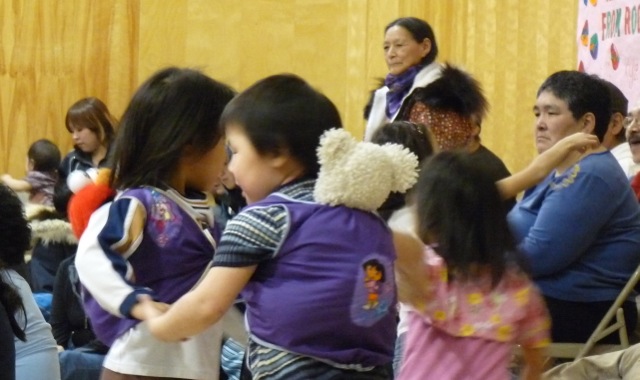
Inuit children in Ikaluktutiak/Cambridge Bay practicing lateral love. Family dance Christmas 2008.
Gestern hatte ich in meinem Blog einen Ausdruck benutzt, der unmittelbare Reaktionen ausgelöst hat. Ich habe die Geringfügigkeit oder Bedeutungslosigkeit des Selbst innerhalb des Universums erwähnt, ohne dem Selbst eine Wesentlichkeit abzusprechen. Später ist mir in den Sinn gekommen, dass ich letztes Jahr in einem Tagebucheintrag einen ähnlichen Gedanke niedergeschrieben habe.
Ein Gedanke über die Ordnung vom Selbst in der höheren Ordnung des Universums: Ich bin ein kleiner, unbedeutender Teil eines viel grösseren Organismus. Trotz dieser Kleinigkeit ist dem Selbst eine eigenständige Bedeutung zugeordnet, weil es doch auch eine Manifestation des Ganzen ist; weil es eigenes Potenzial in sich birgt das substantielles Teil des Grösseren ist, ohne das das Grosse auch nicht komplett ist.
Dies ist kein neuer Gedanke; ich habe dies als Grundlage meines Seins seit Jahren akzeptiert. Ich glaube dass die Idee vom Gedankengut von Mahatma Gandhi beeinflusst ist.
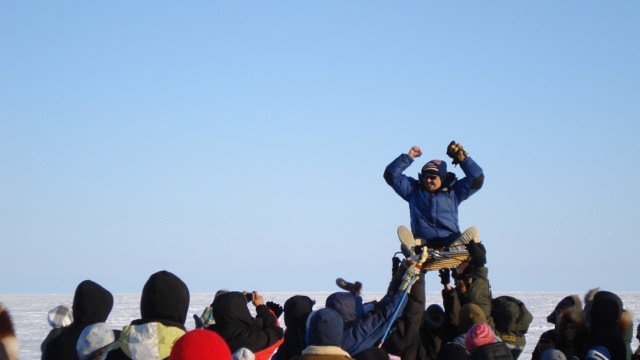
The winner of the 2008 Qavvavik sled dog races in Gjoa Haven, Nunavut, supported by the community in an inhospitable environment.
In a previous post I made the statement that “we are insignificant but essential particles in the universe”. Out the of the entire article, this statement yielded an immediate reaction from the readership. I then recalled that I made a similar entry in my diary last summer during the time I was visiting in Switzerland:
A thought about the rank of self within the higher order of the universe: I am a small, insignificant part of a much larger organism. Despite that smallness, the self is assigned a significance of its own because it is at the same time a manifestation of the whole; also because it bears its own potential within. That potential is a substantial part of the larger organism, without which the whole would not be complete.
(my own translation from German)
I believe this thinking is influenced by the thought of Mahatma Gandhi.
Today is the first day of ‘complete independence’ for me in more than twenty years: My son, my youngest child, has finally reached the milestone of legal adulthood – and thus his independence.
Happy Birthday, Flurin! Celebrate, enjoy, and stay safe!
My son has been longing for while to become more independent, to make his own decisions and take responsibility for them. He has actively practiced stepping out toward a self-determined adult life. Today, he has reached that milestone. Congratulations! Flurin, I will continue to support you on your life journey – no longer as your father and legal guardian, but as Othmar, your father, friend, and mentor if that is possible and desirable. Continue reading “Independence day”→
Invite somebody to read - Lade jemand zum lesen ein:
Dropping off and picking up passengers at the Mao Airport (Kanem Region/Chad)
I find it neat to find common experiences in the most unexpected places. As I was doing some banking today, the investment advisor and I got into some casual conversation. After all, he has all kind of private information about me at his disposal on the computer screen. He inquired about my employment status and whether I am still working with MSF/Doctors WIthout Borders. He showed a genuine interest and so I told him a little bit about my mission to Chad last year. Continue reading “Military-industrial complex: The human version”→
Invite somebody to read - Lade jemand zum lesen ein:
As I spend some more time with the new blogging tool I discover how difficult it is for me to write to an anonymous audience. So far, I have mostly used letters and letter-style emails to communicate. What is it really that people “out there” are interested in? What are the relevant thoughts that I like to share? What am I comfortable with sharing with a wider audience, possibly a public audience?




 OFRADIX