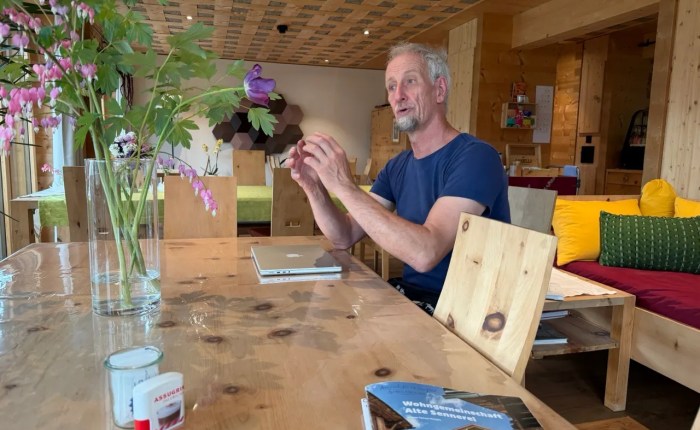
It was a delight to meet Othmar Arnold this past Sunday at the Hospiz in the little Swiss village of Tenna, on a shoulder high above the Safien Valley. The story of our meeting is worth recounting at some length.
by Philippe Vandenbroek
First, about the place. After a relaxing Sunday morning hike I decided to look in at the Sozialraum Café, in an attractive, newish-looking building. As it was my first visit to Tenna I had no idea what to expect and I was surprised to find I had stumbled into an ‘elderly home’. Studying the materials tucked into the menu, however, I quickly understood that this was an extraordinary project with an uncommonly wide view of how care can be organised humanely, sustainably and economically within a neighbourhood setting. In a nutshell: Hospiz Tenna is a residential community offering support for up to eight people in the final stages of life and palliative care. The Sozialraum Café is an integral part of the project, bringing together the residents and the local community of Tenna and beyond, while also offering hikers and visitors like me a place to enjoy a coffee, a snack or a meal in this remote mountain village.
H from Hospitium
Othmar has led a richly varied life that took him to some of the most remote corners of the planet. His pioneering spirit sedimented into a social enterprise that connects to the ethos of reciprocity and care which has animated the vision of ‘hospitium’ for millennia, before it was sucked dry into a cold-hearted palliative business. What happens in Tenna goes beyond the ‘hands-on care’ offered in response to medical needs, the ‘caring for’. Here, care is understood as a social capacity and activity involving the nurturing of all that is necessary for the welfare and flourishing of life. It therefore also encompasses the emotional investment of ‘caring about’, and the political capacity to mobilise and ‘care with’ others (a distinction I borrow from the authors of The Care Manifesto).
The financial and employment model sustaining the Tenna Hospiz — as far as I could grasp from Othmar’s replies — is cogent, balanced, and respectful of universal human needs: subsistence, protection, affection, participation, identity and freedom (in the sense of Manfred Max-Neef’s Barefoot Economics). It also allows for considerable savings, for residents and the wider community alike. And yet regulators are looking askance, and some are actively opposing it. That may sound implausible, but it is the daily reality for the majority of civic innovators and social entrepreneurs. A useful rule of thumb: assume that innovators must invest 80% of their time and resources in interfacing with the established system, leaving the remainder for actual societal value creation. Navigating this, tirelessly looking for ways to turn regulatory grey zones to one’s advantage, requires incredible stamina, a genuine trickster nature, and a considerable appetite for risk.
F from Works of Peace
“Know your enemies!”, Othmar told me, with an impish smile. Not to destroy them, but to keep them off your back while one is engaged in one’s ‘Friedensarbeit’, one’s ‘works of peace’. The foundational paradoxes of I and Thou, and of Life and Death (see an earlier Medium story), that are at the heart of this work, are, as Jo said, not ‘logically foreseeable’. They can only be lived, creating the path by walking it.
Visiting the Tenna Hospice had felt like an exquisite privilege. I left without paying for the soup and coffee that had been served to me. Othmar didn’t bat an eyelid. I went back to settle the bill. He accepted it in the same unruffled manner in which the meal had been offered. Gruezi wohl, Othmar! See you again soon!
Read the full story from Philippe Vandenbroek:
https://philippevandenbroeck.medium.com/works-of-peace-friedensarbeit-b5fac749907e
 OFRADIX