Letting our Light shine

In the last two months, the Quaker Worship Group in Whitehorse witnessed an increased interest in the Quaker tradition of seeking God and the Quaker form of worship. As a very small and very isolated group, the concern of how to build community has been raised on several occasions.

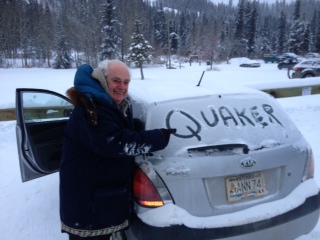
William Swainson - doing Quaker outreach Yukon style at -30 degrees (photo credit: Celia McBride)
William Swainson – doing Quaker outreach Yukon style at -30 degrees (photo credit: Celia McBride)

Within the last year, we have reframed and updated the entry in the listing of religious services in the local newspaper. We have also updated the listing on the website of the Canadian Yearly Meeting and established a dedicated email address. However, the increased interest seems to have come mostly from the relationship-building done by the individuals from our Worship Group.  Continue reading “Letting our Light shine”

Third Sunday of Advent

As the days get shorter and shorter, let us light a candle.As the days get shorter and shorter, let us light a candle.As the days get shorter and shorter, let us light a candle.
As the days are still getting shorter, it is time to light another candle.

A candle is burning, a flame warm and bright,

a candle of hope in December’s dark night

A candle is burning, a candle of peace,

to signal that conflict must cease

(adapted from Voices United)

Continue reading “Third Sunday of Advent”

Yarn bombs needed

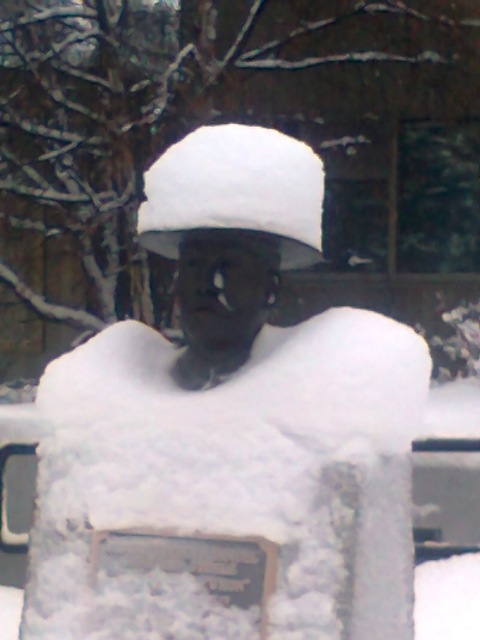
Poor old Sammy Steele, freezing year after year in his NWMP uniform. I like the fluffy cover for his mountie hat and his padded shoulders. But he looks sad, frozen tears on his cheeks. Will anybody out there have some mercy on him and other characters in the streets of Whitehorse? Jack London and Robert Service look cold, too!

Continue reading “Yarn bombs needed”

Walking Home – a short film

“Walking Home – A contemplative journey along the Yukon River” is a short film conceptualized, directed, and produced by Othmar F. Arnold, with feedback and support from Celia McBride; filmed in Whitehorse, Yukon (Canada).

Continue reading “Walking Home – a short film”

Valuing democracy – playing by the rules

I was asked to contribute to the ongoing consultation process for the Peel Watershed Regional Land Use Plan. Here are my thoughts:

Image
Monolith Mountain in the Tombstone Territorial Park. A protected natural space in the Tr’ondëk Hwëch’in traditional territory adjacent to the Peel River watershed.

Feedback Peel Watershed Regional Land Use Plan Consultation

My personal opinion is that the Peel River region has sufficient natural value to be designated as a whole (=100%) a protected area similar to a National Park. However, I see that various stakeholders have an interest in accessing some resources in the Peel River watershed:

For First Nations it is an area for subsistence, primarily fishing, but also hunting, berry picking and the collection of other plant materials for medicinal uses. As the representatives of a colonial power, the Yukon Government also has to realize that the Peel River watershed has spiritual values to the indigenous people of that area, the people that have lived on the land for centuries, that live on the land today, and the ones yet-to-come. This land is part of the people – a concept that is hard to grasp for us Westerners who have developed property rights, buy and sell real estate like a commodity, with no emotional or spiritual attachment, and see us as enlightened beings separate from the natural world.

Continue reading “Valuing democracy – playing by the rules”

A Better Yukon for All – the governmental strategy for social inclusion and poverty reduction

A critical review by Othmar F. Arnold

(All mentioned documents are linked directly to the original source.)

The preamble to the new strategy document outlines very nicely what a better Yukon for all means: “A socially inclusive society is one where all people feel valued, their differences are respected, and their basic needs are met so they can live with dignity. It is a society where everyone has the opportunity to participate and to have their voice heard.’ (p. 8) And it continues with deep insight about social exclusion: it “is the result of barriers in the social, economic, political and cultural systems” (p. 8).

In the introduction, the scope of the strategy is presented as a guideline to social policy development; or in other words, how government will facilitate a way of meaningfully living together. From the research the government conducted, it concluded that service delivery and access to services appear the main reasons for the fact that some people in the Yukon do not feel included. Furthermore, “poverty is one of the most obvious factors contributing to social exclusion, but social exclusion also stems from and is exacerbated by inadequate education, housing, health, social participation, employment and access to services (p. 8)”.

Continue reading “A Better Yukon for All – the governmental strategy for social inclusion and poverty reduction”

A Better Yukon for All – a new strategy paper

The Government of Yukon has recently released its long-awaited

Social Inclusion and Poverty Reduction Strategy

It has been in the works for a while and there were several delays in releasing the document. But I am glad that it has finally seen the light. The entire strategy document can be downloaded from the following page: A Better Yukon. On the same page, the government released the 2010 background research report: Dimensions of Social Inclusion and Exclusion.

A socially inclusive society is one where all people feel valued, differences are respected and basic needs are met so they can live with dignity. Barriers in social, economic, political and cultural systems can prevent people from being part of their community. Everyone is affected by social exclusion and poverty, and everyone plays a role in finding solutions.

Vision

A Yukon where social exclusion and poverty are eliminated, diversity is celebrated, and all Yukoners have the opportunity to prosper and participate to their full potential, free from prejudice and discrimination.

The strategy document provides guiding principles, goals, and a commitment to measure success.

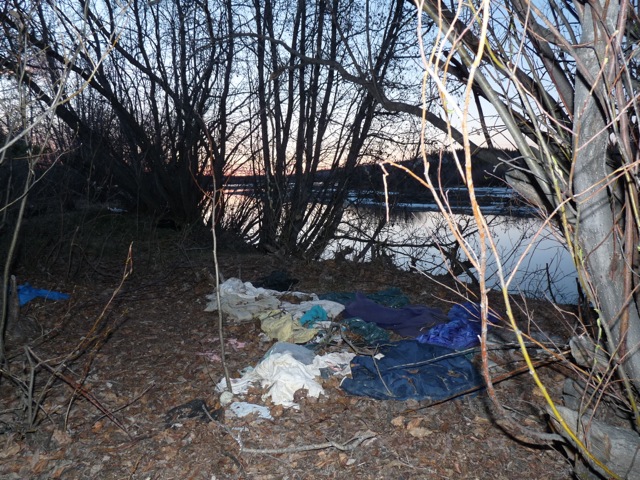
Evidence of Homelessness in Whitehorse: abandoned camp along the Yukon River

Continue reading “A Better Yukon for All – a new strategy paper”

Landfillharmonic

Dear Friends,
please enjoy and get inspired by this teaser film for a documentary called “LandFillharmonic” I found on an other blogsite. It is excellent evidence that we can make the best out of whatever we have, even if we have nothing!

“One day it occurred to me to teach music to the children of the recyclers and use my personal instruments,” explains 36 year-old Chávez, who worked as an ecological technician at the landfill. “But it got to the point that there were too many students and not enough supply. So that’s when I decided to experiment and try to actually create a few.”

Working beside the families for years Chávez eventually made friends and became acutely aware that the children needed something positive in their lives. He was inspired to do something to help. He began using the trash in the landfill to create instruments for the children.

The town of Cateura was built virtually on top of a landfill. Situated along the banks of the Paraguay River, the landfill receives over 1,500 more tons of solid waste each day. There are seven different neighborhoods built around the landfill, accounting for over 2500 families living in close proximity to dangerous waste. Most of the families, including children, are employed by the landfill as recyclers. The poverty has forced children to work in the landfills, neglecting any education that might lead them to a better life. (from: artjournal.com)

It matches the powerful message of my own film project about community development, empowerment, and resourcefulness “Healing in Babalmé”. Watch the short film on YouTube or follow this link:

Hope on the Horizon – the movie

Here is the link to the Landfillharmonic video: The world sends us garbage…

yogaleigh's avatarScribblings from the Bluegrass

Check this out:

View original post

Second Sunday of Advent

As the days get shorter and shorter, let us light a candle.As the days get shorter and shorter, let us light a candle.
It is time to light another candle.

Enjoy the virtual light and warmth from the candles. Now I would like you invite you for a different blog entry. Continue reading “Second Sunday of Advent”

A sorry state – the loss of democracy (+de)

A Sorry State (für eine deutsche Teilübersetzung klicke hier: Ein leider Zustand)

Last week, the Available Light Cinema film series in Whitehorse screened the new documentary by local director Mitch Miyagawa with the catchy title “A Sorry State”. Indeed, much of what we read in the news about politics, be it at the level of the territorial government, the federal government, or many national governments around the world, supports the impression that this world is in a sorry state.

But do not fear: I am not going to write a lament about our current political situation. I’ll leave that for other writers in local newspapers that dared to describe our cage-fighting MP a sock puppet of the Prime Minister… (Yukon News)

The sorry state in Miyagawa’s film refers to the various apologies his extended family has received over the last decade from the government of Canada for political wrongs of its colonial history: Continue reading “A sorry state – the loss of democracy (+de)”

Last Stop for Miles (The Feature Film) – Teaser released

Celia McBride released the teaser for her feature film production Last Stop for Miles. It is available on YouTube.

“When running away brings you back…”

The feature is expected to be released in spring 2013. For more information on the movie and its production on location in the Yukon, visit: Last Stop for Miles

For a list of cast and crew, please go to the credits page.

The (personal) impact of working with Doctors without Borders (+de)

Community mobilization and health education during a malnutrition crisis in Babalmé/Chad

The following article has just been published this week in The Canadian Friend, 108(5) p.13 , a publication of the Canadian Yearly Meeting of the Religious Society of Friends. You can find the current and many back issues online: The Canadian Friend.

Für eine deutsche Übersetzung klicke hier:
Arbeiten mit Ärzte ohne Grenzen – der Einfluss auf mein persönliches Leben

Médecins Sans Frontières / Doctors Without Borders in Chad

by Othmar F. Arnold

I have been asked: “How did this service work change me? What impact did the experiences have on my life?”

I must acknowledge that I have not been working as a nurse since that time. I am not the same person as before the mission. A major shift began in my life several years ago. I was called back to my roots, to become radical again, and there were other factors enabling a mid-life reorientation

My children were growing up and becoming more and more independent. Though the high-paying nursing work in Nunavut enabled me to liberate myself from financial obligations accumulated over the years, I was becoming less and less convinced by the direction nursing was going.

Continue reading “The (personal) impact of working with Doctors without Borders (+de)”

The time for giving – global needs you would have never dreamed of

Over the last few days, I came across several writings in the blogosphere about aid. It started with the blog from a Norwegian family that inquired whether providing employment for a person from a marginalized context (read: Third World country) could potentially constitute a form of development aid at the private, most direct level.

Is hosting an au pair the most direct form of developmental aid maybe?
I´m not being cynical. It is a sincere question. (from Au pair host: “Development Aid?“)

In response, I offered some of my own thoughts for finding an answer:

…However, I have some doubts about the notion of development aid. In the first case, the mother and child have migrated from the less affluent to the more affluent context due to marriage. They have uprooted themselves to significantly improve their social and hopefully economic standing – this is what I call upward mobility. There is no development in Kenya associated with that.
In the second case, the young woman has returned with hard earned and saved cash and is able to run a family business. At least that will have a development effect in the country of origin. But the process is a form of migrant labour, or maybe another form of remittance.
I think that if a person from a marginalized country comes and works as au pair in a highly privileged country and is treated like a human being and not simply as cheap labour, it is a noble exchange.
But it does not constitute charity:

Nick Negerli - the ubiquitous guilt-absorbing church collection boxes of a recent past (photo credit: vgntramp.wordpress.com)
(photo credit: vgntramp.wordpress.com)

Continue reading “The time for giving – global needs you would have never dreamed of”

Hope on the horizon – the movie (+de)

Healing in Babalmé – A story of hope from a marginalized place tells the story of a humanitarian worker’s lived experiences during a malnutrition crisis in Chad, where a pastoralist community on the edge of the Sahara desert mobilizes its own resources to overcome effects of marginalization. This short experimental documentary is a witness to the power of supportive non-intervention and true community development.

für eine deutsche Übersetzung klicke hier: Hoffnung in Babalmé
I am pleased to announce, that my creative spirits have persisted, thanks to the encouragement of Celia and others, to revise and re-edit the animated audio-visual presentation based on my experiences in Chad. I still feel blessed that I have been able to witness the events that inspired me to write the story. They are still a source of hope for me. The events illustrate for me that there is “that of God in everyone”: People with nothing can make a difference if we don’t crush their individual and collective agency with might and paternalistic intentions.

I am planning to submit this version to the Dawson City International Short Film Festival 2013.

DCISFFlogo

It will be another venue to share the message of hope with a wider audience.
You can enjoy the preview in this YouTube version anytime by clicking the arrow button:

Dedicated to the people of Babalmé and the North Kanem/Chad Continue reading “Hope on the horizon – the movie (+de)”

Becoming a Quaker in a fragmented world (+de)

The Friends Meeting House in Victoria, BC. The Quaker community is celebrating the 100th anniversary of their meeting house in 2013. (photo credit: Vancouver Island MM)

Für eine deutsche Übersetzung, klicke hier: Quäker werden in einer fragmentierten Welt

Now it is official, I have been accepted into membership of the Religious Society of Friends. I would like to share a quote from the report of the clearness committee that helped me discern whether becoming a Quaker is the right step for me and the Victoria Friends Meeting at this time:

…His readings, experience and deep reflections about his spiritual journey and its congruence with his life of service led him to apply for membership after some email exchanges and conversations with VFM members.

Our clearness committee enjoyed a lively visit with Othmar.  He exhibits a remarkable mix of delightful enthusiasm and direct, serious, and practical commitment to humane principals.  He also has deeply realistic expectations about his service without cynicism or romanticism.  We appreciated his good natured story-telling which was appropriately serious without solemnity.  We feel that he is committed to spiritual openings compatible with our understanding of Quaker faith and practice.  He seeks to deepen his spiritual life with support from Quakers and in particular our Victoria Meeting…

…We recommend his acceptance into membership with joy and the conviction that our conjoined spiritual lives of worship and service will benefit.

This is a big step for me. Continue reading “Becoming a Quaker in a fragmented world (+de)”