Faithful – half full – unfaithful

I have never been faithful, nor have I ever promised faithfulness in my life. And that’s the truth. My truth. Since I am not absolute, it could not be the absolute truth. Nonetheless, I stick with that truth, which makes me steadfast, and that is what faith is about. So, am I faithful after all, and thus not speaking the truth in the first place?

"Snow on the Water" - near Swan Lake, King William Island, Nunavut
“Snow on the Water” – near Swan Lake, King William Island, Nunavut

I hardly believe that worldly things are true. Just because you or I have witnessed something, and because you or I recall an event with certain confidence, does not make them true. An action might have been the right thing to do, or it might have been justifiable from a particular point of view.

How would I know that something is so true that I believe in it? I would have to trust – in an action faith – that my observation has no bias whatsoever. So, can a person who does not believe in the truth be a faithful person, or would such a person automatically be unfaithful?

I guess it depends. But certain things are unconditional and as such would not depend. They are, and I am certain of them. For instance, I believe in the good of every human being, but I don’t believe that any such being knows the truth; at least some truth – yes, and from a unique point of view. And I believe in the common good – because we are all One.

Since I have no proof for the above statements, nor have I observations to support these claims, I need to believe them – which makes me faithful again. Or at least half full. But never unfaithful.

And you can believe me or not, without loosing your faith.

.

more on being faithful here

Banking and integrity – the good side of money

For the third time in my life, I have become co-owner of a bank. This seems like a contradiction for a person who embraces voluntary poverty, strives for a simple life, aspires to the ideal of non-possession. Well, I call it a necessity on the way.

The meaning this step has for me is the reason why I feel led to share this unspectacular event in a person’s life with you. I am very critical of the consumerist-capitalist paradigm and dominant economic system. I am deeply suspicious about the integrity of the banking system. These banking institutions embody much of what I see is missing the mark in the global discourse of affluence.

Intriguing pattern of light - Art installation by Niki Saint Phalle in the historic grotto at the Royal Herrenhäuser Gardens in Hannover, Germany
Intriguing pattern of light – Art installation by Niki Saint Phalle in the historic grotto at the Royal Herrenhäuser Gardens in Hannover, Germany

Continue reading “Banking and integrity – the good side of money”

Stephen Harper is gone – thank God

It is a little more than a month that I have been using this blog site as a platform to express my views, share some experiences, and tell a few stories. In the last week, I heard some feedback, that the Canadian Prime Minister’s image would appear along side my blog entries on people’s screens, promoting some form of debt relief.


Now that was hard to take. A Quaker’s writing in which he is trying to uphold the principle of and write from a point of integrity being visually associated with the leader of a government culture and structure that has earned very little credibility in that department.


Continue reading “Stephen Harper is gone – thank God”

Valuing democracy – playing by the rules

I was asked to contribute to the ongoing consultation process for the Peel Watershed Regional Land Use Plan. Here are my thoughts:

Image
Monolith Mountain in the Tombstone Territorial Park. A protected natural space in the Tr’ondëk Hwëch’in traditional territory adjacent to the Peel River watershed.

Feedback Peel Watershed Regional Land Use Plan Consultation

My personal opinion is that the Peel River region has sufficient natural value to be designated as a whole (=100%) a protected area similar to a National Park. However, I see that various stakeholders have an interest in accessing some resources in the Peel River watershed:

For First Nations it is an area for subsistence, primarily fishing, but also hunting, berry picking and the collection of other plant materials for medicinal uses. As the representatives of a colonial power, the Yukon Government also has to realize that the Peel River watershed has spiritual values to the indigenous people of that area, the people that have lived on the land for centuries, that live on the land today, and the ones yet-to-come. This land is part of the people – a concept that is hard to grasp for us Westerners who have developed property rights, buy and sell real estate like a commodity, with no emotional or spiritual attachment, and see us as enlightened beings separate from the natural world.

Continue reading “Valuing democracy – playing by the rules”

A sorry state – the loss of democracy (+de)

A Sorry State (für eine deutsche Teilübersetzung klicke hier: Ein leider Zustand)

Last week, the Available Light Cinema film series in Whitehorse screened the new documentary by local director Mitch Miyagawa with the catchy title “A Sorry State”. Indeed, much of what we read in the news about politics, be it at the level of the territorial government, the federal government, or many national governments around the world, supports the impression that this world is in a sorry state.

But do not fear: I am not going to write a lament about our current political situation. I’ll leave that for other writers in local newspapers that dared to describe our cage-fighting MP a sock puppet of the Prime Minister… (Yukon News)

The sorry state in Miyagawa’s film refers to the various apologies his extended family has received over the last decade from the government of Canada for political wrongs of its colonial history: Continue reading “A sorry state – the loss of democracy (+de)”

The (personal) impact of working with Doctors without Borders (+de)

Community mobilization and health education during a malnutrition crisis in Babalmé/Chad

The following article has just been published this week in The Canadian Friend, 108(5) p.13 , a publication of the Canadian Yearly Meeting of the Religious Society of Friends. You can find the current and many back issues online: The Canadian Friend.

Für eine deutsche Übersetzung klicke hier:
Arbeiten mit Ärzte ohne Grenzen – der Einfluss auf mein persönliches Leben

Médecins Sans Frontières / Doctors Without Borders in Chad

by Othmar F. Arnold

I have been asked: “How did this service work change me? What impact did the experiences have on my life?”

I must acknowledge that I have not been working as a nurse since that time. I am not the same person as before the mission. A major shift began in my life several years ago. I was called back to my roots, to become radical again, and there were other factors enabling a mid-life reorientation

My children were growing up and becoming more and more independent. Though the high-paying nursing work in Nunavut enabled me to liberate myself from financial obligations accumulated over the years, I was becoming less and less convinced by the direction nursing was going.

Continue reading “The (personal) impact of working with Doctors without Borders (+de)”

The time for giving – global needs you would have never dreamed of

Over the last few days, I came across several writings in the blogosphere about aid. It started with the blog from a Norwegian family that inquired whether providing employment for a person from a marginalized context (read: Third World country) could potentially constitute a form of development aid at the private, most direct level.

Is hosting an au pair the most direct form of developmental aid maybe?
I´m not being cynical. It is a sincere question. (from Au pair host: “Development Aid?“)

In response, I offered some of my own thoughts for finding an answer:

…However, I have some doubts about the notion of development aid. In the first case, the mother and child have migrated from the less affluent to the more affluent context due to marriage. They have uprooted themselves to significantly improve their social and hopefully economic standing – this is what I call upward mobility. There is no development in Kenya associated with that.
In the second case, the young woman has returned with hard earned and saved cash and is able to run a family business. At least that will have a development effect in the country of origin. But the process is a form of migrant labour, or maybe another form of remittance.
I think that if a person from a marginalized country comes and works as au pair in a highly privileged country and is treated like a human being and not simply as cheap labour, it is a noble exchange.
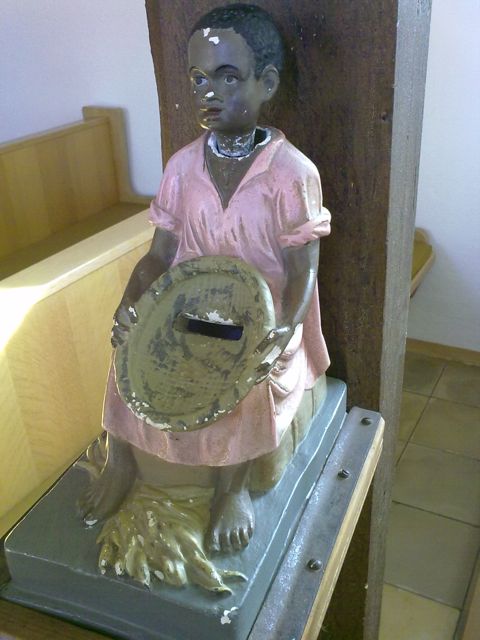
But it does not constitute charity:

Nick Negerli - the ubiquitous guilt-absorbing church collection boxes of a recent past (photo credit: vgntramp.wordpress.com)
(photo credit: vgntramp.wordpress.com)

Continue reading “The time for giving – global needs you would have never dreamed of”

Becoming a Quaker in a fragmented world (+de)

The Friends Meeting House in Victoria, BC. The Quaker community is celebrating the 100th anniversary of their meeting house in 2013. (photo credit: Vancouver Island MM)

Für eine deutsche Übersetzung, klicke hier: Quäker werden in einer fragmentierten Welt

Now it is official, I have been accepted into membership of the Religious Society of Friends. I would like to share a quote from the report of the clearness committee that helped me discern whether becoming a Quaker is the right step for me and the Victoria Friends Meeting at this time:

…His readings, experience and deep reflections about his spiritual journey and its congruence with his life of service led him to apply for membership after some email exchanges and conversations with VFM members.

Our clearness committee enjoyed a lively visit with Othmar.  He exhibits a remarkable mix of delightful enthusiasm and direct, serious, and practical commitment to humane principals.  He also has deeply realistic expectations about his service without cynicism or romanticism.  We appreciated his good natured story-telling which was appropriately serious without solemnity.  We feel that he is committed to spiritual openings compatible with our understanding of Quaker faith and practice.  He seeks to deepen his spiritual life with support from Quakers and in particular our Victoria Meeting…

…We recommend his acceptance into membership with joy and the conviction that our conjoined spiritual lives of worship and service will benefit.

This is a big step for me. Continue reading “Becoming a Quaker in a fragmented world (+de)”

Experiments in living – to govern or not to govern

Experiments in living – multicultural lichen colony with a funny face on Boothia Peninsula, Nunavut.

Today, I got drawn into an online conversation. It started with the following blog entry: Experiments in Living and its subsequent exchange of replies that eventually touched on the issue of need and structure of government. From the exchange I got the sense that government seems to be categorically opposite to the notion of liberty, as well as that certain national governments are being viewed as completely separate from and in opposition to the population. For me the latter seems peculiar and indicates a fundamental flaw of existing government structures. I have posted earlier some of my own thoughts about governance under the heading leadership and power – not authoritarian rule and legalized force.


Here I will share with you my reply to the above-mentioned online dialogue:

Dear Malcolm,

I am not sure if smaller government is my preferred vision in general.

Continue reading “Experiments in living – to govern or not to govern”

Namenstag: Othmar

for an English version: Feast Day: Othmar

Otmar wuchs wahrscheinlich in einer angesehenen alemannischen Familie am Bodensee auf. Er wurde dort auch geschult und später nach Chur zum Studium geschickt. Nach der Priesterweihe wurde er im Pfarreidienst eingesetzt. Im Alter von dreissig Jahren wurde er beauftragt im Steinachtal bei der Zelle des Gallus ein Kloster zu errichten.

Otmar hatte eine ausgeprägte soziale Ader, verschenkte Klostervermögen an die Armen, baute in der Nähe des Klosters das erste Haus für Aussätzige in der Schweiz und nahm Kranke, Blinde und Arme in einem weiteren Bau auf, wo er sie auch nachts selbst betreute; die enge Verbindung der Klosterbrüder zum einfachen Volk begründete Missionserfolge und brachte ihm den Namen Armenvater ein. Er fürchtete den wachsenden Reichtum seines Klosters und kleidete sich selbst einfach, ritt nur auf einem Esel statt auf einem Pferd. (Ökumenisches Heiligenlexikon)

Continue reading “Namenstag: Othmar”

Feast Day: Othmar

für eine deutsche Version: Namenstag: Othmar

Today I am going to tell you a story of a gifted little boy born on the shores of Lake Constance. He grew up in a place where he would speak an Alamannic German at home and Latin in more formal settings. He was born into a privileged family: He got the chance to go to school at an early age. The intent was to groom him for service in the royal administration. For his postsecondary education he is being sent abroad where people speak Romansch. There he lives in a palace with the family of a powerful mentor. After he mastered the sciences, he continued to study theology and became a priest.

The young man wanted to return to the shores of Lake Constance, but his mentor had a strategic placement for him in mind. He served for a number of years as parish priest and gained a reputation for compassionate service and his special attention for the marginalized. Eventually, he got called by an even more powerful landlord to establish a monastery in the woods of the Steinach valley. The local ruler secured a royal order to do so, and thus to establish a cultural and religious defence post on the margins of competing jurisdictions.

Abbot Otmar (photo source: http://www.santiebeati.it)

Continue reading “Feast Day: Othmar”

Die Bedeutung der Geringfügigkeit des Selbst

Gestern hatte ich in meinem Blog einen Ausdruck benutzt, der unmittelbare Reaktionen ausgelöst hat. Ich habe die Geringfügigkeit oder Bedeutungslosigkeit des Selbst innerhalb des Universums erwähnt, ohne dem Selbst eine Wesentlichkeit abzusprechen. Später ist mir in den Sinn gekommen, dass ich letztes Jahr in einem Tagebucheintrag einen ähnlichen Gedanke niedergeschrieben habe.

Ein Gedanke über die Ordnung vom Selbst in der höheren Ordnung des Universums: Ich bin ein kleiner, unbedeutender Teil eines viel grösseren Organismus. Trotz dieser Kleinigkeit ist dem Selbst eine eigenständige Bedeutung zugeordnet, weil es doch auch eine Manifestation des Ganzen ist; weil es eigenes Potenzial in sich birgt das substantielles Teil des Grösseren ist, ohne das das Grosse auch nicht komplett ist.

Dies ist kein neuer Gedanke; ich habe dies als Grundlage meines Seins seit Jahren akzeptiert. Ich glaube dass die Idee vom Gedankengut von Mahatma Gandhi beeinflusst ist.

Continue reading “Die Bedeutung der Geringfügigkeit des Selbst”

The significance of the insignificance of self

significance of insignificance
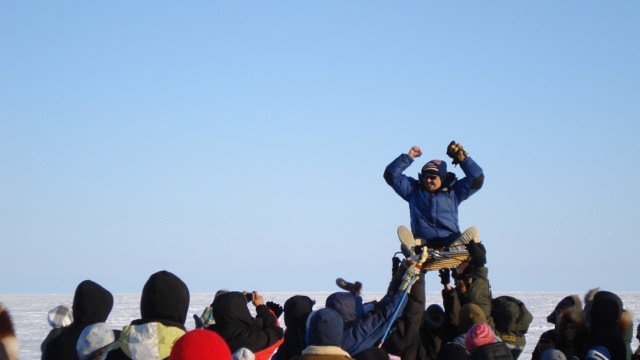
The winner of the 2008 Qavvavik sled dog races in Gjoa Haven, Nunavut, supported by the community in an inhospitable environment.

In a previous post I made the statement that “we are insignificant but essential particles in the universe”. Out the of the entire article, this statement yielded an immediate reaction from the readership. I then recalled that I made a similar entry in my diary last summer during the time I was visiting in Switzerland:

A thought about the rank of self within the higher order of the universe: I am a small, insignificant part of a much larger organism. Despite that smallness, the self is assigned a significance of its own because it is at the same time a manifestation of the whole; also because it bears its own potential within. That potential is a substantial part of the larger organism, without which the whole would not be complete.

(my own translation from German)

I believe this thinking is influenced by the thought of Mahatma Gandhi.

Continue reading “The significance of the insignificance of self”

Don’t waste your time!

I was brought up with the mantra don’t waste your time. My parents were quite insistent that their children make the most of their time (and definitely not waste theirs). Only now do I realize that this attitude was not something purely utilitarian – a way to make it out of misery and to the top. It actually has biblical roots:

Make best use of the time, because the days are evil. Eph 5:16 (ESV)

for a German version of this article: Verschwende deine Zeit nicht!

For my parents’ and grandparents’ generation making most of their time seemed to have worked. They all have roots in an agrarian lifestyle – something that for the most part excluded options in life, and was equally associated with a good measure of back-breaking labour, servitude, misery and poverty. But they overcame the burden thereof and created for themselves a much more comfortable worldly existence.

Continue reading “Don’t waste your time!”

Leadership and power – not authoritarian rule and legalized force

I am more comfortable knowing that Barack Obama will be president of the US of America for another four years. Not that I doubt that Mitt Romney and his team have equal abilities to govern that big country. What makes the difference for me is the perceived difference in attitude about governance.

My impression is that Obama wants to be a leader. He radiates a vision of a nation – even if he is not immune to hints of global supremacy. On the other hand, the Republican rhetoric sounds to me like they want to be in power. The conservative notion seems to dictate to be in charge of the whole world, to dominate. For me there is a very clear difference and important distinction between leadership and power: One is to unleash the inner motivation of the people, of society and polity as a whole, to do the best they can for a common purpose; the other one is to force one particular set of beliefs and actions on everyone like the emperors and popes did in centuries past. Continue reading “Leadership and power – not authoritarian rule and legalized force”