Over the last few days, I came across several writings in the blogosphere about aid. It started with the blog from a Norwegian family that inquired whether providing employment for a person from a marginalized context (read: Third World country) could potentially constitute a form of development aid at the private, most direct level.
Is hosting an au pair the most direct form of developmental aid maybe?
I´m not being cynical. It is a sincere question. (from Au pair host: “Development Aid?“)
In response, I offered some of my own thoughts for finding an answer:
…However, I have some doubts about the notion of development aid. In the first case, the mother and child have migrated from the less affluent to the more affluent context due to marriage. They have uprooted themselves to significantly improve their social and hopefully economic standing – this is what I call upward mobility. There is no development in Kenya associated with that.
In the second case, the young woman has returned with hard earned and saved cash and is able to run a family business. At least that will have a development effect in the country of origin. But the process is a form of migrant labour, or maybe another form of remittance.
I think that if a person from a marginalized country comes and works as au pair in a highly privileged country and is treated like a human being and not simply as cheap labour, it is a noble exchange.
But it does not constitute charity:
Healing in Babalmé – A story of hope from a marginalized place tells the story of a humanitarian worker’s lived experiences during a malnutrition crisis in Chad, where a pastoralist community on the edge of the Sahara desert mobilizes its own resources to overcome effects of marginalization. This short experimental documentary is a witness to the power of supportive non-intervention and true community development.
für eine deutsche Übersetzung klicke hier: Hoffnung in Babalmé
I am pleased to announce, that my creative spirits have persisted, thanks to the encouragement of Celia and others, to revise and re-edit the animated audio-visual presentation based on my experiences in Chad. I still feel blessed that I have been able to witness the events that inspired me to write the story. They are still a source of hope for me. The events illustrate for me that there is “that of God in everyone”: People with nothing can make a difference if we don’t crush their individual and collective agency with might and paternalistic intentions.
It will be another venue to share the message of hope with a wider audience.
You can enjoy the preview in this YouTube version anytime by clicking the arrow button:
The Friends Meeting House in Victoria, BC. The Quaker community is celebrating the 100th anniversary of their meeting house in 2013. (photo credit: Vancouver Island MM)
Now it is official, I have been accepted into membership of the Religious Society of Friends. I would like to share a quote from the report of the clearness committee that helped me discern whether becoming a Quaker is the right step for me and the Victoria Friends Meeting at this time:
…His readings, experience and deep reflections about his spiritual journey and its congruence with his life of service led him to apply for membership after some email exchanges and conversations with VFM members.
Our clearness committee enjoyed a lively visit with Othmar. He exhibits a remarkable mix of delightful enthusiasm and direct, serious, and practical commitment to humane principals. He also has deeply realistic expectations about his service without cynicism or romanticism. We appreciated his good natured story-telling which was appropriately serious without solemnity. We feel that he is committed to spiritual openings compatible with our understanding of Quaker faith and practice. He seeks to deepen his spiritual life with support from Quakers and in particular our Victoria Meeting…
…We recommend his acceptance into membership with joy and the conviction that our conjoined spiritual lives of worship and service will benefit.
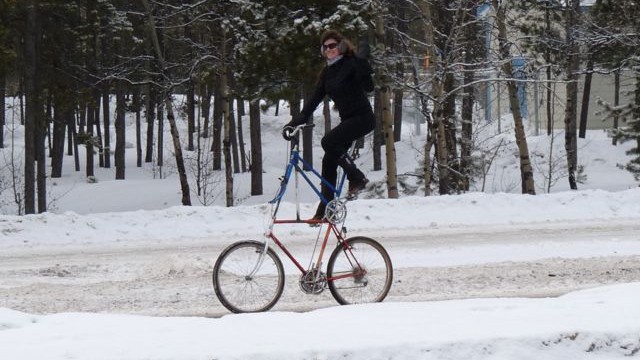
Have you ever been frustrated by your bicycle commuting, especially in winter when the conveniently usable road surface starts to decrease due to accumulation of snow ploughed to the side of the road where two-wheeled commuters usually drive in absence of a designated bike trail system or bike lanes? Here is a tip that made an enormous difference for me:
Bell testing the tall bike in Whitehorse on wintery roads.
Two winters ago, Australian penny farthing champion Bell Chamberlain visited Whitehorse and the Yukon Territory. She inspired us to build a tall bike from old bicycle parts that were lying around in the back yard. Merci beaucoup, Philippe! No it was not pretty, but it quickly became a head turner in Whitehorse.
“Hope on the Horizon” screenshot from the online version of the MSF Canada magazine Dispatches 16(2), Summer 2012
I still remember my first visit to Babalme in July 2011. The MSF vehicle had to use a local guide to point at indistinguishable features on the horizon, a lone tree or a sand dune, to direct us more than twelve kilometers off the last known track in the desert sand. It was a bleak picture. The area was drier than the rest of the Sahel, not a single mud brick building, no school, no health centre – just people living a pastoralist life in a forgotten corner of Chad and close to the border with Niger.
It looks like many readers have seen and hopefully enjoyed the initial posting on the “Teach me to stop and listen” song that was shared with the Whitehorse Worship Group by the Quaker Worship Group in Lucknow, Ontario. Next Sunday, our group will practice and sing the song for the first time at the beginning of our monthly meeting for worship.
As I experiment will all kinds of social networking sites (and learn from my children who are much more proficient users), I was able to upload the simple recording of my own arrangement of the song that I wrote about a few days back on this blog. Continue reading “Teach me to stop and listen again”→
Invite somebody to read - Lade jemand zum lesen ein:
Experiments in living – multicultural lichen colony with a funny face on Boothia Peninsula, Nunavut.
Today, I got drawn into an online conversation. It started with the following blog entry: Experiments in Living and its subsequent exchange of replies that eventually touched on the issue of need and structure of government. From the exchange I got the sense that government seems to be categorically opposite to the notion of liberty, as well as that certain national governments are being viewed as completely separate from and in opposition to the population. For me the latter seems peculiar and indicates a fundamental flaw of existing government structures. I have posted earlier some of my own thoughts about governance under the heading leadership and power – not authoritarian rule and legalized force.
Here I will share with you my reply to the above-mentioned online dialogue:
Dear Malcolm,
I am not sure if smaller government is my preferred vision in general.
The last few workdays, I had a chance to be with people in a professional manner again. Yes, it is in many ways a different way of being, no matter what the personal intention behind it is. There is often a very clear mandate, a professional framework, and whole lot of professional culture that determines in various ways the interactions and relationships in such a setting. I have considerable experience in the field of nursing, which operates within the health care system. This most recent experience was in the field of education. I found many commonalities in how we as professionals relate to those in our care.
The most limiting factor I find is the schedule – the work hours. Although the job mandates to relate to people, work hours are a very foreign framework: They are governed by transactional considerations in collective agreements, agency funding, institutional culture, and individual rights and responsibilities. I find this internally inconsistent with the mandate of being with – of relating to people with multiple needs. How often are we forcing our professional expertise (“we know what to do, what is best for you”), our learning goals and plans, our labour benefits (such as break times) onto the individual lives of those who we care for during work hours? It is not possible to catch that learning window when it is open, we have to pry it open: It is time to do crafts, music therapy, spell and sign… because our schedule demands it at this point.
Many times I have been frustrated by these constraints. But I have also witnessed, that it is so much easier, successful, and satisfying to be with people and weave the learning goals and activities into daily living (instead of simulating a formal lesson): Why not sing and engage in musical activity when the person we are caring for is open to engage, even if it is while out on a walk? The squirrels and ravens don’t mind if I sing and if we clap the rhythm to the song together.
A creative result of applied math and social studies: Grittibänz baking for Dec. 6 celebration (Nicholas of Myra feast day)
I remember the days when we home schooled our children. We never did any formal math classes for three years: our children learned their additions, subtractions, multiplications and divisions by working with and adjusting recipes to bake muffins or cup cakes. Continue reading “Life-long learning – a professional and a monastic path”→
Invite somebody to read - Lade jemand zum lesen ein:
Grace to you and peace from the One who is and who was and who is to come (Rev. 1:4).
I offered my service as a reader today to the congregation at Whitehorse United Church, and the above quote was part of the readings. On occasion, I do worship with the local United Church congregation. As these things go, they have a relational aspect: I have been invited to join for the worship service; and Celia has been attending this church for a while now. To read from the scripture is a way for me to give back to the community and their hospitality. It helps me to overcome my fear for public speaking and my tendency not to publicly live out and share the ministry of presence.
I must admit that the space the Whitehorse United Church provides for worship is exceptional in the architectural desert of the Yukon. The sanctuary is simple, inviting, and not overloaded with distractions. I particularly enjoy the indirect light from the rainbow-coloured window glass in the alcove behind the altar. Today was not the best day for appreciating the light effects because the skies produced a diffuse light. But on a day with some sunshine, these windows create the warmest glow of light throughout the visible spectrum. A real treasure and for me an expression of the above quote from the Revelation to John.
No it’s not the end, yet! Light effects in the sanctuary of Whitehorse United Church (photo credit: Whitehorse United Church)
I have never required a particular place to experience God, the divine: most often this happens to me when I am out in the bush, close to the creation and at the same time away from the distractions of civilizations. Continue reading “Grace to you and peace from the One”→
Invite somebody to read - Lade jemand zum lesen ein:
Membership and belonging are important factors for well-being on an individual level. It is a topic that resonates strongly with me for a long time. In 2004/05, I have written an article on community membership and belonging from a nursing perspective with a particular focus on cross-cultural practice in indigenous communities. It was never published, but might be of interest to some.
Nursing practice with Aboriginal communities: An exploration of the question of membership.
Othmar F. Arnold, RN, MN,
Abstract
For most nurses working with Aboriginal people, such a posting is a professional challenge. Nurses do not hold any formal membership in the cultural and ethnically diverse communities they serve. The importance is placed on competent and efficient delivery of needed services for populations that are known for significant health disparities and marginalization. Drawing from Nuu-chah-nulth origin stories, it appears to be important for the realization of Aboriginal health, healing, and well being that health professionals acquire community membership. The difference between the two world views poses an ethical dilemma, possibly constituting a form of cultural imperialism. Nursing science based approaches for bridging the intercultural gap are explored.
Health Centre, Carmacks, Yukon, serving the Village of Carmacks and the Little Salmon/Carmacks First Nation
Today I learned through a follower of this blog about an important indigenous healing initiative in Australia. It is called Lateral Love Australia and is intended to explore and help overcome the opposite of lateral love: Lateral violence.
Lateral violence happens when people who are both victims of a situation of dominance, in fact turn on each other rather than confront the system that oppresses them both.
I was touched by this initiative. I have witnessed many instances where people in marginalized communities I served in were hurting each other. Instead of pulling together towards healing from various forms of colonial trauma, people engage in acts of lateral violence (gossip, bullying, blaming, alcoholism, drug use, domestic violence, suicide). This only creates more hurt and pain, helps reinforce stereotypes, and perpetuates racism.
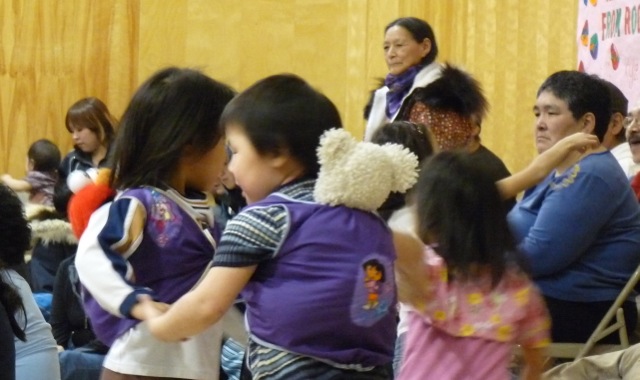
Inuit children in Ikaluktutiak/Cambridge Bay practicing lateral love. Family dance Christmas 2008.
Otmar wuchs wahrscheinlich in einer angesehenen alemannischen Familie am Bodensee auf. Er wurde dort auch geschult und später nach Chur zum Studium geschickt. Nach der Priesterweihe wurde er im Pfarreidienst eingesetzt. Im Alter von dreissig Jahren wurde er beauftragt im Steinachtal bei der Zelle des Gallus ein Kloster zu errichten.
Otmar hatte eine ausgeprägte soziale Ader, verschenkte Klostervermögen an die Armen, baute in der Nähe des Klosters das erste Haus für Aussätzige in der Schweiz und nahm Kranke, Blinde und Arme in einem weiteren Bau auf, wo er sie auch nachts selbst betreute; die enge Verbindung der Klosterbrüder zum einfachen Volk begründete Missionserfolge und brachte ihm den Namen Armenvater ein. Er fürchtete den wachsenden Reichtum seines Klosters und kleidete sich selbst einfach, ritt nur auf einem Esel statt auf einem Pferd. (Ökumenisches Heiligenlexikon)
Today I am going to tell you a story of a gifted little boy born on the shores of Lake Constance. He grew up in a place where he would speak an Alamannic German at home and Latin in more formal settings. He was born into a privileged family: He got the chance to go to school at an early age. The intent was to groom him for service in the royal administration. For his postsecondary education he is being sent abroad where people speak Romansch. There he lives in a palace with the family of a powerful mentor. After he mastered the sciences, he continued to study theology and became a priest.
The young man wanted to return to the shores of Lake Constance, but his mentor had a strategic placement for him in mind. He served for a number of years as parish priest and gained a reputation for compassionate service and his special attention for the marginalized. Eventually, he got called by an even more powerful landlord to establish a monastery in the woods of the Steinach valley. The local ruler secured a royal order to do so, and thus to establish a cultural and religious defence post on the margins of competing jurisdictions.
As I was looking in a contemplative gaze out the window – into a wintery morning scene with freshly blowing snow and some lights shining from the roof of a construction site across the street – I felt this gentle urge, this longing, to be doing something with my hands. I had this instant flash of memory of the project I was working off and on all summer long: a tiny house on wheels. I imagined how ideal it would be to have such an ongoing project set up and waiting for those moments where my hands call for meaningful activity.
The becoming of my passive-solar-design-tiny-house-on-a-trailer in summer 2012
But my little project is set aside for the winter. Choosing to embrace a simple lifestyle and not to maintain a permanent place to live has its consequences: I am not always in control and have to accept what the respective circumstances allow. Setting up the tiny house project within easy reach was not feasible this winter. Alas!






 OFRADIX