Various Friends observed during a recently held retreat on theSpirituality of John Woolman how amazing it was that the main concerns raised by Woolman some 250 years ago were still current today. On the surface it seems unlikely: we no longer have to deal with slave trading, stage coaches, or buttons as unnecessary things on clothes. However, the way we relate to and treat people, mainly the ones that are not the way we are, and the matters of business and commerce are still very much on the agenda today.
As a child of the sixties I am used to see problems and injustices, to denounce them, and to call for solutions. Together with my generation I was shocked by the witnessed use of violence in Biafra, the recognition of the limits of energy resources, and the advancing pollution of our environment. The grievances affected us and we eagerly sought solutions to turn away the disasters, which seemed to threaten our privileged lifestyles. We collected for charities, travelled by train from one meeting to another, and bought many of our consumer products grown organically or trade through alternative market channels.
Während einer kürzlich abgehaltenen Retraite zum Thema Spiritualität von John Woolman bezeugten verschiedene Freunde, dass es erstaunlich sei wie aktuell die Grundanliegen, die Woolman vor 250 Jahren vorbrachte, heute noch sind. Oberflächlich betrachtet scheint das unwahrscheinlich, denn wir müssen uns nicht mehr mit Slavenverkauf, Postkutschen, oder Knöpfen als Überflüssigkeiten an Kleidern auseinander setzen. Doch die Thematiken des Umgangs mit den Menschen, vor allem denen die nicht sind wie wir, und des Umgangs mit unseren Angelegenheiten und Geschäften sind nach wie vor höchst aktuell.
Als ein Kind der Sechziger Jahre bin ich mir gewohnt, Probleme und Ungerechtigkeiten zu sehen, an zu prangern und nach Lösungen zu rufen. Ich war mit meiner Generation schockiert über die Zeugnisse von Gewaltanwendung aus Biafra, die Verknappung der Energiereserven, die fortschreitende Verschmutzung der Umwelt. Die Missstände machten uns betroffen und wir suchten eifrig nach Lösungen um die Katastrophen ab zu wenden, die unsere privilegierten Lebensweisen zu bedrohen schienen. Wir sammelten für Hilfswerke, reisten mit dem Zug von einer Versammlung zur andern, und erstanden viele unserer Konsumgüter aus biologischen Anbau oder alternativen Marktkanälen.
What is a Quaker? – a brief, illustrative, and humorous answer provided from the insights of a Quaker scholar.
Excerpt from the 2013 Quaker Study Series at the Canadian Yearly Meeting by Ben Pink Dandelion.
For the full lecture in five parts, please go to the following page: http://vimeo.com/user20788368/videos
Invite somebody to read - Lade jemand zum lesen ein:
Warum also sollte ich mir Sorgen machen?
Es ist nicht meine Angelegenheit, an mich zu denken.
Meine Angelegenheit ist es an Gott zu denken.
Es ist Gottes Sache an mich zu denken. (Simone Weil)
(English version below)
Zitat aus: Mystik und Widerstand: Du Stilles Geschrei, von Dorothee Sölle
Lichen colony in an inhospitable environment on Boothia Peninsula, Nunavut.
„Why should I be anxious?
It is not up to me to think of myself.
It is up to me to think of God.
And it is up to God to think of me.” (translation by Barbara and Martin Rumscheidt)
Quote from: The Silent Cry: Mysticism and Resistance by Dorothee Soelle
Invite somebody to read - Lade jemand zum lesen ein:
In some parts of Europe in the Middle Ages, there was an Easter tradition called risus paschalis, or “Easter laughter.” After Vespers and Benediction, the priest would regale his congregation with comical stories and jokes, often fables with a moral point to make. After the somber weeks of Lent, the laughter was both a reward and a release. The tradition died out following the Protestant Reformation, but perhaps it will make a comeback. Happy Easter! (from cathedralliturgy.blogspot.ch)
Osterlachen bezeichnet den Brauch, in der Predigt an Ostern die Gottesdienstgemeinde zum Lachen zu bringen. In einigen Regionen war es vom 14. bis 19. Jahrhundert fester Bestandteil des christlichen Brauchtums. Zu diesem Brauch gehörte es, in der Osterpredigt eine Geschichte zu erzählen, die die Gemeinde zum Lachen brachte. Der Grundgedanke des Osterlachens war die Osterfreude zum Ausdruck zu bringen. Das Osterlachen war auch eine lustige Art, ein wenig Kritik an der weltlichen oder kirchlichen Obrigkeit zu üben. Frohe Ostern! (aus Wikipedia)
Here an attempt to share the Easter laughter:
The Pope comes to the Pearly Gates and rings the bell. Peter responds quickly and opens the door. “Welcome to heaven. Who are you, my guest?” “I am the Pope, your successor in the apostolic office in Rome” says the pope with a hint of disappointment in his voice. “I have no idea who you are and what you are talking about. Let me quickly ask my boss!” As soon as Peter finished speaking, God the Omnipresent appeared. “How can I help you?” she said to the Pope. “I am the Pope. I am your representative on earth.” God raises her eyebrows and falls into deep silence for a short time. Then she says to the Pope: “I am sorry. I don’t recognize you and I am not clear what you are talking about. But let me consult with my son.” God sent an instant message to Jesus. He arrives at heaven’s door without delay and greets the Pope. He takes him aside, inquires about his concerns, and engages him in a conversation. After a while, Jesus comes back with a big grin on his face: “I wasn’t aware that the fisherman’s club we formed two thousand years ago was still in existence!”
Versuche ob dich die folgende Geschichte zum Lachen bringen kann.
Der Papst kommt zum Himmelstor und klingelt. Petrus eilt herbei und öffnet. “Gegrüsst seiest du. Wer bist du denn?” “Ich bin der Papst, ich bin dein Nachfolger im apostolischen Amt in Rom” sagt dieser mit einem Anflug von Enttäuschung in seiner Stimme. “Ich habe keine Ahnung wer du bist und wovon du sprichst. Lass mich mal meinen Boss fragen!” Kaum hat Petrus das gesagt, ist Gott der Allgegenwärtige da. “Ja, bitte?” spricht sie den Papst an. “Ich bin der Papst. Ich bin dein Stellvertreter auf Erden.” Gott runzelt ihre Stirn und versinkt in ein kurzes, tiefes Schweigen. Danach sagt sie zum Papst: “Es tut mir leid. Ich erkenne dich nicht und mir ist nicht klar wovon du sprichst. Aber, lass mich mal bei meinem Sohn nachfragen.” Gott sendet eine Instant-Message zu Jesus. Der kommt auch gleich an die Himmelspforte und begrüsst den Papst. Er nimmt ihn zur Seite, erkundigt sich nach dem Anliegen des unbekannten Gastes, und unterhaltet sich mit ihm. Dann kommt Jesus zurück, mit einem grossen Schmunzeln im Gesicht: “Ich war mir nicht bewusst dass dieser Fischer-Verein, den wir vor zweitausend Jahren ins Leben riefen, immer noch existiert!”
Statue of Nicholas de Flue, a 15th century ascetic and hermit – credited for peace building advice to various governments. – Statue von Bruder Klaus in der Jesuitenkirche in Luzern. Seine Ratschläge an verschiedene Regierungen gelten als friedensstiftened.
The ascetic in the palace
Der deutsche Text folgt weiter unten
A hermit lived in a simple dwelling outside city limits. He was revered as a holy ascetic; many people were seeking his advice. Even the head of government became aware of him. She wanted to get to know this man. One day, she appeared in front of the cabin and asked him, whether he wanted to move up to her stately house.
“If you think so”, replied the hermit, “I will follow you anywhere.”
The head of government was surprised, but did not loose her composure. She did not anticipate that the hermit would accept her offer. Would a true ascetic not have to refuse such an offer? The head of government had some doubt. But, because she made the offer, she took the man to her stately house where she arranged for a beautiful and comfortable room and a delicious meal.
Ich bitte für den neugewählten Papst Franziskus, dass er die Kraft hat der Radikalität/Verwurzelung seines Namenspatrons in Taten und Worten gerecht zu werden im neuen Amt und dass auch er einer Klara begegnen kann mit der er gemeinschaftlich und charismatisch die Nachfolge Jesu leben und das Amt als Bischof von Rom führen kann.
I pray for the newly elected Pope Francis: may he, in his new office, have the strength to live up to the radical ways/the rootedness of his namesake in words and deeds, and may he encounter a Clare with whom he may, in community and charismatically, live the following of Jesus and lead the ministry as Bishop of Rome.
Stained glass installation depicting the life of Francis of Assisi. Demindere Franciscus Museum in Sint-Truiden.
Invite somebody to read - Lade jemand zum lesen ein:
Ich bin was ich bin, weiss was ich bin, und muss mich nicht anpassen nur weil du grösser, stärker, rentabler, und dominierender bist. Ein Haus an der Obergrundstrasse in Luzern das schon seit meiner Kindheit immer quer steht. – I am what I am, I know who I am, and I don´t have to assimilate just because you are bigger, stronger, more profitable, and more dominant. This house in Lucerne has, as far back as I can remember, been misaligned in the eyes of modern city planners.
Sich quer stellen:
der bewusste Entscheid sich nicht treiben zu lassen von Modeströmungen.
der bewusste Entscheid sich nicht treiben zu lassen von Ängsten.
der bewusste Entscheid, Einzigartigkeit und konsumorientierter Individualismus miteinander zu verwechseln.
der bewusste Entscheid nicht auf Kosten anderer zu leben.
der bewusste Entscheid sich nach Werten und Prinzipien zu orientieren, die man mit dem eigenem Gewissen vereinbaren kann.
der bewusste Entscheid sich nach Werten und Prinzipien zu orientieren, die man nach reiflicher Prüfung als göttlicher Wille erkannt hat.
Bewusst leben. Einzigartig sein.
(English version below)
“Demut heißt sich nicht vergleichen. In seiner Wirklichkeit ruhend ist das Ich weder besser noch schlechter, weder größer noch kleiner als anderes oder andere. Es ist – nichts, aber gleichzeitig eins mit allem.” (Dag Hammarskjöld, aus dem Buch: Zeichen am Weg)
Der Bauer: Tafel 45 des Totentanzes auf der Spreuerbrücke in Luzern – The Peasant: Panel 45 of the Dance of Death series on the Spreuer Bridge in Lucerne.
Ach Pur wie sur gwünst du dein Brot. – Ich gwüns mit Arbeit Angst und Not. –
Wil läben doch lieber ein Pursman. – Als gstorben für ein Edelman.
Bergahorn, allein auf weiter Flur [in der Nähe des Kraftortes Heiligkreuz] – A solitary Great (or Sycamore) Maple tree [near Heiligkreuz, a place of strength in Switzerland].
Heute möchte ich ein Gebet mit dir teilen, das in poetischer Weise beschreibt woher einige meiner Gedanken stammen die die Grundlage sind für viele meiner Blogeinträge. Es gibt mir Kraft, diesen Weg weiter zu gehen.
Gott,
lege Worte mir in den Mund,
die über das hinaus reichen, was erreichbar ist.
Die über das hinaus denken,
was denkbar ist.
Die sich mehr wünschen
und mehr vorstellen,
als ich mir wünschen und vorstellen kann. Continue reading “Verdichten (+en)”→
Invite somebody to read - Lade jemand zum lesen ein:
Turbocharged with the cherry juice from the orchards of my hosts (Cherryfarm Bakkershof in Brustem) and the memories of the eccentric gifts of the historic Christina, who was born in this very place, I set out into a warm and grey mid-winter day. 13 degrees Celsius, I need to dress down significantly!
The showers were frequent throughout the day. As I walked along the trail, I started to understand why the oldest settlements were in locations that we would call ‘holes’: These depressions are a natural protection from the strong winds that happen to blow frequently in this flat landscape. If it weren’t for the many groves and rows of sheltering trees, it would feel like on the islands in the Canadian Arctic.
This morning, I have left Antwerp by train. The beautiful weather from yesterday is gone, replaced by the one that I would have expected for this region and this time of the year: A rainy grey, but at least not freezing.
It was good to get on the train, to put some distance to the port and the city. And the landscape changed slowly, from the urban to the industrial, from the commercial to the suburban, then fields and forest, creeks and towns. I feel better in these more rural settings. Although Antwerp did not strike me as extremely loud in term of ubiquitous advertising and commercial overstimulation, I was able to feel that hollowness of the commercialized city life.
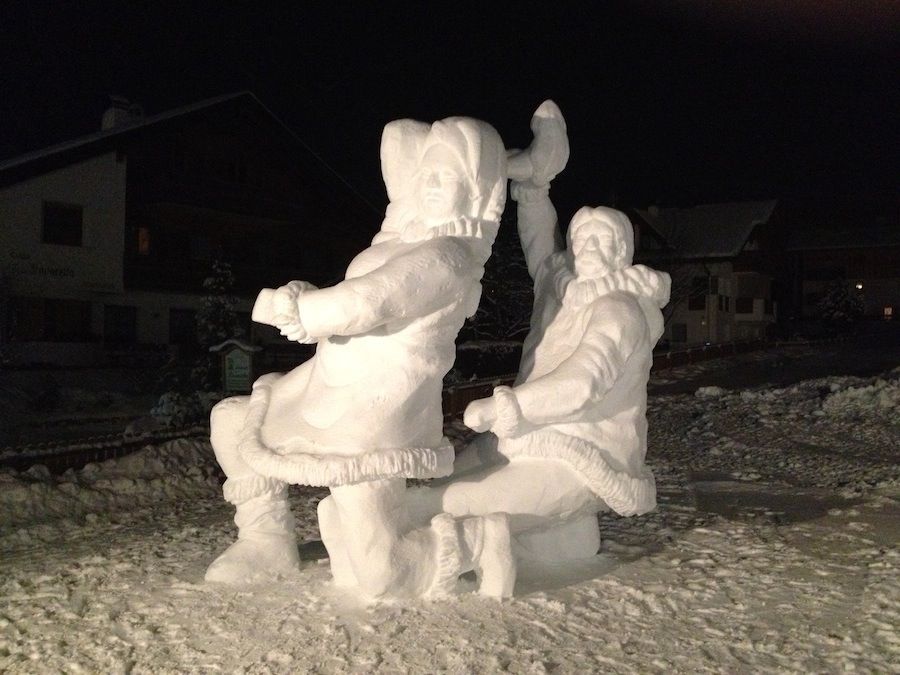
The Brave Hunter and the Walrus – Team Canada (photo credit: Donald C. Watt/snowcarver.ca)
The Brave Hunter and the Walrus
There once was a brave hunter who harpooned walruses to feed his village. This hunter would travel far out on the ice flows to where the giant walruses like to sun themselves. Once when hunting, he harpooned a giant walrus and was pulling it in when the walrus lunged forward to attack the brave hunter. At the same time the wife of the walrus came rising up under the ice flow the brave hunter was standing on trying to safe her husband.
Der Tapfere Jäger und das Walross
Es war einmal ein tapferer Jäger der Walrosse harpunierte um sein Dorf zu ernähren. Dieser Jäger reiste weit auf die Eisschollen hinaus, wo sich die riesigen Walrosse gerne sonnten. Auf einer dieser Jagden harpunierte er ein riesiges Walross und zog es zu sich hin. Da stürzte sich das Walross vorwärts um den tapferen Jäger angreifen. Zur gleichen Zeit kam die Frau des Walross an die Oberfläche von unterhalb der Eisscholle, auf der der tapfere Jäger stand, um zu versuchen ihren Mann zu retten.
Il Cacciatore Coraggioso e il Tricheco
C’era una volta un cacciatore coraggioso che arpionava trichechi per nutrire il suo villaggio. Questo cacciatore viaggiava lontano sul ghiaccio fino alla località, dove i trichechi giganti prendevano il sole. Una volta, il cacciatore aveva arpionato un tricheco gigante e lo stava tirando verso lui, quando il tricheco si lanciò in avanti per attaccare il cacciatore coraggioso. Allo stesso tempo, la moglie del tricheco si avvicinava da sotto il ghiaccio marino che il cacciatore coraggioso era in piedi, per provare a salvare suo marito.
First place Snow Festival in San Vigilio 2013:
Sister Sun and Brother Moon – Team Canada (photo credit: Donald C. Watt/snowcarver.ca)
Sister Sun and Brother Moon
A long time ago when the only light in the world was fire, the people lived in large round houses. In one such house a brother would always chase his sister around the fire. One time, while running around the fire, the sister grabbed up a brightly burning stick and headed outside the house to escape her brother, but brother then grabbed a small twig that burned less bright and ran out after her. They ran around and around the house but brother could not catch sister. They kept on running until they realized they were running across the sky. Sister’s brighter fire became the sun and Brothers dimmer light became the moon. Today you can still see Sister Sun and Brother Moon running circles across the sky.
Schwester Sonne und Bruder Mond
Vor langer Zeit, als das einzige Licht in der Welt Feuer war, lebten die Menschen in großen, runden Häusern. In ein solches Haus rannte ein Bruder immer seiner Schwester um das Feuer herum nach. Einmal, während dem sie um das Feuer herum lief, packte die Schwester einen hell brennenden Stab und ging aus dem Haus, um ihren Bruder zu entkommen. Der Bruder aber dann packte einen kleinen Zweig, der weniger hell brannte, und lief ihr nach. Sie liefen im Kreis um das Haus herum, aber der Bruder konnte nicht die Schwester nicht fangen. Sie rannten bis sie erkannten, dass sie am Firmament gingen. Das helle Feuer der Schwester wurde die Sonne und das schwächere Licht des Bruders wurde der Mond. Noch heute kann man sehen wie Schwester Sonne und Bruder Mond am Himmel kreisen.
Sorella Sole e Fratello Luna
Molto tempo fa, quando l’unica luce del mondo era il fuoco, la gente viveva in grandi case rotonde. In una casa un fratello avrebbe sempre inseguire la sorella intorno al fuoco. Una volta, durante il giro intorno al fuoco, la sorella ha afferrato un bastone luminoso ardente e si diresse fuori la casa per sfuggire al suo fratello, ma lui poi afferrò un piccolo ramoscello che bruciava meno brillante e corse dietro. Correvano intorno e intorno alla casa ma fratello non poteva prendere la sorella. Hanno continuato a correre fino che essi sono reso conto che corrono attraverso il cielo. Il fuoco brillante della sorella divenne il sole e la luce del fratello divenne la luna. Oggi è ancora possibile di vedere la Sorella Sole e il Fratello Luna giranti attraverso il cielo.
Invite somebody to read - Lade jemand zum lesen ein:
Norwegian icebreaker at work on a river in Northern Canada – Norwegischer Eisbrecher im Einsatz auf einem Fluss im Norden Kanada’s (photo credit: joe-ks.com)
But the gate is narrow and the way is difficult that leads to life, and there are few who find it. – Denn die Pforte ist eng und der Weg ist schmal, der zum Leben führt; und wenige sind es, die ihn finden. (Mt. 7:14)
As silly as the scene in the picture looks, it represents several important lessons for me:
A problem always has a solution.
Direct action can be more effective than waiting for outside/government help.
Self-help is more sustainable than professional solutions.
Employ the simplest means to get a job done.
Make the best with what you have.
Live your life adventurously!
What does this picture represent for you?
So blöd wie die Szene im Bild erscheinen mag, ich ziehe mehrere Lehren daraus:
Für jedes Problem gibt es eine Lösung.
Direkter Einsatz kann viel effektiver sein als auf Hilfe von aussen/der Regierung zu warten.
Selbsthilfe ist dauerhafter als eine professionelle Lösung.
Wende die einfachsten Hilfsmittel an um eine Arbeit auszuführen.
Mach das Beste mit dem was du hast.
Lebe dein Leben abenteuerlich!
Was sagt dir denn dieses Bild?
A good person out of the good treasury of the heart will bring forth that which is good; – Der gute Mensch bringt aus dem guten Schatz seines Herzens das Gute hervor. (Lk. 6:45)
Invite somebody to read - Lade jemand zum lesen ein:



![Bergahorn, allein auf weiter Flur [in der Nähe des Kraftortes Heiligkreuz] - A solitary Great (or Sycamore) Maple tree [near Heiligkreuz, a place of strength].](https://ofradix.net/wp-content/uploads/2013/02/sunnehuegel6.jpg)



 OFRADIX