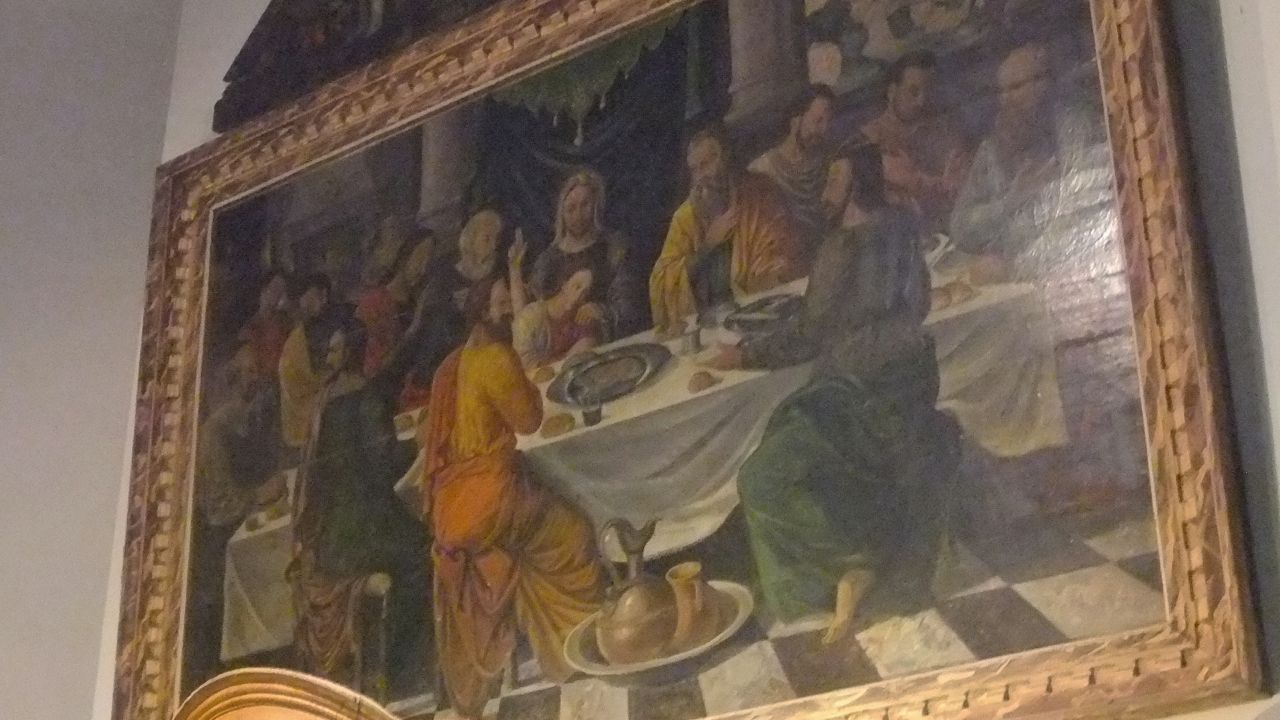
“The Last Supper – Abendmahl”. Painting in the rural chapel of Helshoven in Belgium by an unknown painter of a Flemish school (16th century). Gemälde eines unbekannten Malers aus einer flämischen Schule in der Kapelle eines ehemaligen Johanitterspitals in Helshoven, Belgien (16. Jh)
During meditation this morning, it occurred to me that Maundy Thursday is the day during the lenten season and the holy week that embodies the calling of my life: To be of compassionate service and to live in community. Maundy Thursday is the day of the biblical last supper and the foot-washing ceremony, two strong symbols for community and service.
I took the above picture during my journey on foot through Belgium. In the following article, you can read how I came across this painting that is not quite a Rubens, but nonetheless left a strong impression with me. En route – from Brustem to Tongeren (Belgium) , with more pictures here: Brustem to Tongeren (the pictures)
Während der heutigen Morgenmeditation wurde mir klar, dass der Gründonnerstag der Tag ist während der Fastenzeit und Karwoche, der meine Berufung im Leben am besten verkörpert: Im Dienste des Nächsten und gemeinschaftlich Leben. Am Gründonnerstag wird in der christlichen Tradition das letzte Abendmahl und die Fusswaschungszeremonie gefeiert. Das sind zwei starke Symbole für Dienst am Nächsten und Gemeinschaft.
Das obige Bild habe ich unterwegs durch Flandern in einer kleinen Kapelle geknipst. Im folgenden Beitrag kannst du mehr erfahren über die Reise die mich zu diesem Bild führte, das zwar kein Rubens ist, aber doch einen starken Eindruck bei mir hinterlassen hat. En route – von Brustem nach Tongeren (Belgien) mit mehr Bildern von unterwegs: Brustem nach Tongeren (die Bilder)
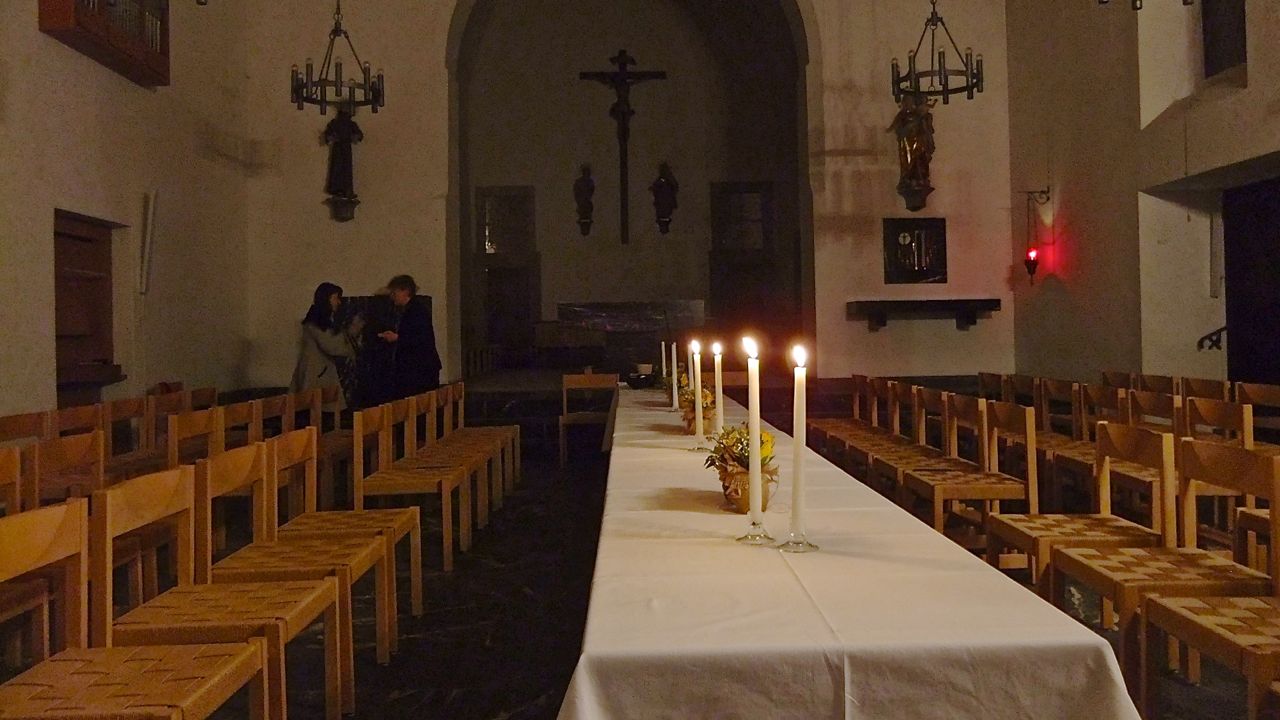
The Last Supper celebration set-up at the Capuchin friary in Rapperswil. – Der Tisch ist gedeckt für die Abendmahlsfeier in der Kapuzinerkirche in RapperswilInviting the community to the table! – Die Gemeinde an den gemeinsamen Tisch einladen!
Invite somebody to read - Lade jemand zum lesen ein:
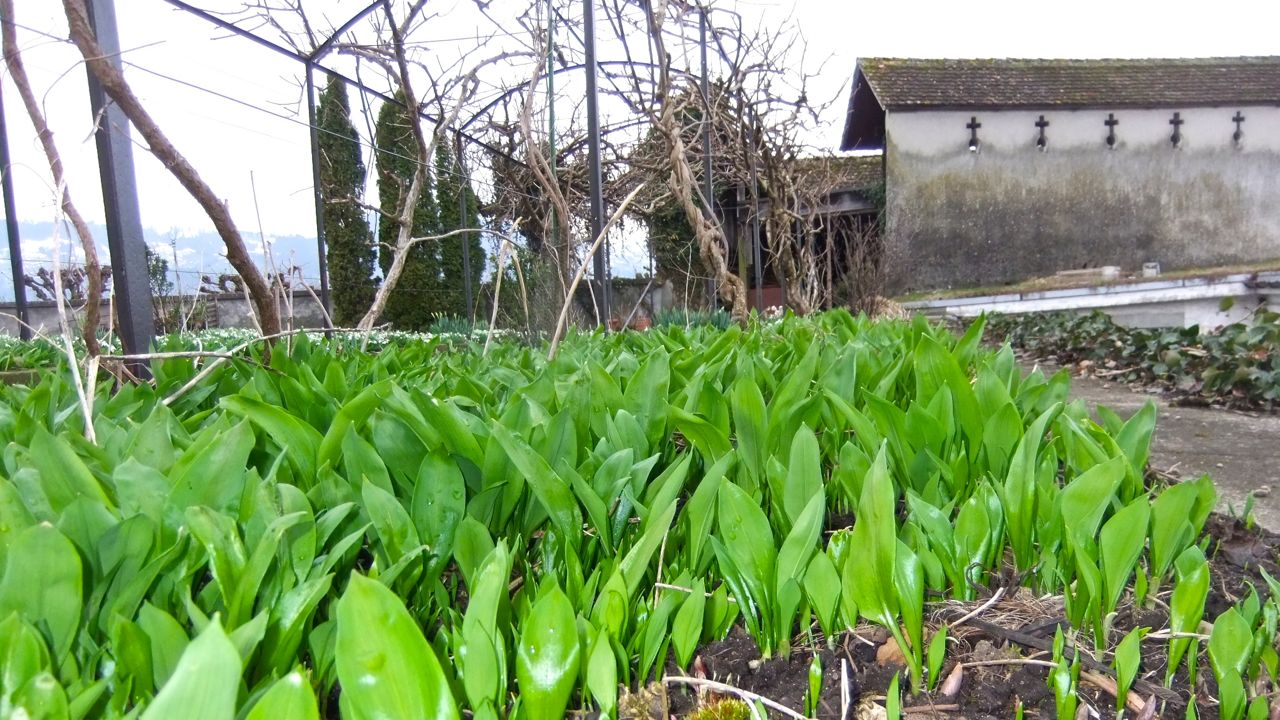
Allium ursinum (Bärlauch; Wild Garlic) in the monastery garden at Rapperswil. This unassuming green is a welcomed addition to the early spring diet, providing a source of enjoyment and well-being for those who set out to harvest it.
Die deutsche Übersetzung folgt weiter unten.
Let us celebrate the beginning of spring, the season of fresh greens and hope. The thoughts on wealth were inspired by a comment on the story of the ascetic in the palace.
Celia shared her thoughts to the story: “People with wealth often feel guilty about being wealthy because there are so many in this world who live in poverty. Therefore, they cannot enjoy the wealth that they have because of those who have not. But what Love says is this: Enjoy it but do not be attached to it. We are invited to indulge in the luxuries that life has to offer but we need to remember that it does not really belong to us and therefore, we must be prepared to walk away from it, give it away and/or let it go at any time.”
There is much truth in her observations. The ascetic in the story never made any judgement on the wealth of the powerful. Nonetheless, I am very reluctant to endorse the enjoyment of wealth in such universal terms. Continue reading “Enjoying the wealth – Das Geniessen von Wohlstand”→
Invite somebody to read - Lade jemand zum lesen ein:
Statue of Nicholas de Flue, a 15th century ascetic and hermit – credited for peace building advice to various governments. – Statue von Bruder Klaus in der Jesuitenkirche in Luzern. Seine Ratschläge an verschiedene Regierungen gelten als friedensstiftened.
The ascetic in the palace
Der deutsche Text folgt weiter unten
A hermit lived in a simple dwelling outside city limits. He was revered as a holy ascetic; many people were seeking his advice. Even the head of government became aware of him. She wanted to get to know this man. One day, she appeared in front of the cabin and asked him, whether he wanted to move up to her stately house.
“If you think so”, replied the hermit, “I will follow you anywhere.”
The head of government was surprised, but did not loose her composure. She did not anticipate that the hermit would accept her offer. Would a true ascetic not have to refuse such an offer? The head of government had some doubt. But, because she made the offer, she took the man to her stately house where she arranged for a beautiful and comfortable room and a delicious meal.
Ich bitte für den neugewählten Papst Franziskus, dass er die Kraft hat der Radikalität/Verwurzelung seines Namenspatrons in Taten und Worten gerecht zu werden im neuen Amt und dass auch er einer Klara begegnen kann mit der er gemeinschaftlich und charismatisch die Nachfolge Jesu leben und das Amt als Bischof von Rom führen kann.
I pray for the newly elected Pope Francis: may he, in his new office, have the strength to live up to the radical ways/the rootedness of his namesake in words and deeds, and may he encounter a Clare with whom he may, in community and charismatically, live the following of Jesus and lead the ministry as Bishop of Rome.
Stained glass installation depicting the life of Francis of Assisi. Demindere Franciscus Museum in Sint-Truiden.
Invite somebody to read - Lade jemand zum lesen ein:
Ich bin was ich bin, weiss was ich bin, und muss mich nicht anpassen nur weil du grösser, stärker, rentabler, und dominierender bist. Ein Haus an der Obergrundstrasse in Luzern das schon seit meiner Kindheit immer quer steht. – I am what I am, I know who I am, and I don´t have to assimilate just because you are bigger, stronger, more profitable, and more dominant. This house in Lucerne has, as far back as I can remember, been misaligned in the eyes of modern city planners.
Sich quer stellen:
der bewusste Entscheid sich nicht treiben zu lassen von Modeströmungen.
der bewusste Entscheid sich nicht treiben zu lassen von Ängsten.
der bewusste Entscheid, Einzigartigkeit und konsumorientierter Individualismus miteinander zu verwechseln.
der bewusste Entscheid nicht auf Kosten anderer zu leben.
der bewusste Entscheid sich nach Werten und Prinzipien zu orientieren, die man mit dem eigenem Gewissen vereinbaren kann.
der bewusste Entscheid sich nach Werten und Prinzipien zu orientieren, die man nach reiflicher Prüfung als göttlicher Wille erkannt hat.
Bewusst leben. Einzigartig sein.
(English version below)
“Demut heißt sich nicht vergleichen. In seiner Wirklichkeit ruhend ist das Ich weder besser noch schlechter, weder größer noch kleiner als anderes oder andere. Es ist – nichts, aber gleichzeitig eins mit allem.” (Dag Hammarskjöld, aus dem Buch: Zeichen am Weg)
Obedience is very often understood in relation to the fact that one gives orders and others obey. Obedience is of great importance in hierarchical systems, such as the army, where obedience is imperative and non-obedience leads to punishment. The same is true in the church, where obedience is a special virtue and leads to salvation. Non-obedience is a guide to hell in various church organizations and denominations. But even the seemingly value-free market economy demands absolute obedience. According to proponents of a neo-liberal economic paradigm, influencing the invisible market forces will only lead to misfortune: therefore are government regulations, and other considerations and interventions for the common good responsible for all the ills of today’s consumer society. Continue reading “Obedience – Gehorsam”→
Invite somebody to read - Lade jemand zum lesen ein:
Bei der Ankunft im ehemaligen Kapuziner Kloster, dem heutigen Haus der Gastfreundschaft, ist eine grosse, steinerne Gedenktafel sichtbar. Obwohl die Tafel in erster Line auf die Baugeschichte des historischen Gebäudes verweist, lässt sich aus dem ersten Satz viel Vorgeschichte heraus lesen:
„Zur Beruhigung der bitteren Untertanen schickte nach dem Bauernkrieg von 1653 der Rat von Luzern die Kapuziner nach Schüpfheim und erbaute ihnen auf eigene Kosten hier, wo bisher ein Galgen mit Überresten hingerichteter Bauernführer stand, Kirche und Kloster.
Der Bauernkrieg war ein Aufstand der rechtlosen Landbevölkerung. Die Bauern hatten genug von der politischen Bevormundung und der wirtschaftlichen Ausbeutung und Benachteiligung durch die mächtigen Stadtherren. Continue reading “Ausgrenzung, Unterdrückung, und Widerstand (+en)”→
Invite somebody to read - Lade jemand zum lesen ein:
When I think about the extent of misery I described in “Mapping it out”, there are many questions that come up for me:
When is this misery, this crisis going to end? This statement implies where we generally see the problem: The misery of “poverty amidst prosperity” seems to be the apparent problem that needs to be addressed. Why else would we find evidence of hundreds of charities and social services initiatives, both from the public and the private sector in Kensington?
Poverty is not the problem – Affluence is!
The early church fathers (5th century) have formulated it this way: “Some people are indigent for the very reason that others hold a superfluity. Take away the rich man and you will find no pauper. No one should own more than is necessary but everyone should have what they need. A few rich people are the reason why there are so many poor” (Pelagius, as cited by Wallis, p.116)
There is nothing wrong with wealth in its original meaning of the word: Being well. But affluence has nothing to do with well-being.
Affluence in the United States refers to an individual’s or household’s state of being in an economically favorable position in contrast to a given reference group.” (Wikipedia)
Jim Wallis describes how that dynamic of maneuvering into a favourable position for individuals, households, or corporations has led to a rat race that is ultimately destructive for the world. We seem to have lost some old fashioned values, like the concern for the common good. It is a sense of individual entitlement (“it’s all about me!”), and the instant gratification of wants (“and I want it now!”) that has taken over.
And we are not satisfied if we have all we need: The consumerist discourse suggests that we need to compete and get ahead of everybody else. Keeping up with the Joneses is one of the symptoms of affluenza, a non-medical disease that has become widespread in affluent societies:
Af-flu-en-za n. 1. The bloated, sluggish and unfulfilled feeling that results from efforts to keep up with the Joneses. 2. An epidemic of stress, overwork, waste and indebtedness caused by dogged pursuit of the American Dream. 3. An unsustainable addiction to economic growth.”(http://www.pbs.org/kcts/affluenza/)
Wallis describes how the market has become like a god. It is all-powerful, all-knowing, and all-present. We have subjected ourselves to the power of the market forces to the point where we start realizing and suffering from the symptoms of affluenza: This unfulfilled feeling.
However, the market does not give you the comfort of the divine. It is not all-loving. If we feel unfulfilled, the market will produce yet another consumable for us and will give us the promise that everything will be taken care of. It sounds like providence
Kensington is a prime example of the hollowness of that market providence. It is not meant to be shared among all human beings. It is not meant to be shared for the sustained well-being of all of creation. Most of us are aware that natural resources are limited. We have made everything on this planet and beyond a commodity that can be exploited for short term gain. Few decisions are driven by the concern of the seventh generation from now.
A perpetual and unregulated growth society needs millions of impoverished and middle-class people that sacrifice themselves and contribute to the extreme accumulation of wealth by a few. Wallis gives stunning examples of the growing gap between the rich and the rest in America and the world. The 400 wealthiest people in the United States control more assets than the 160,000,000 people at the bottom end of the wealth spectrum together!
And the gap is widening every year. That is why I am convinced that poverty is not the problem. Once we rediscover that we are happier with less, and that we are all in this together, we will be heading towards a state of providence. If we redesign our economy and polity, as an expression of the divine will, there will be enough to meet the needs of every human being.
Street scene along Providence Road in Media, PA
In the meantime, the self-proclaimed “road to providence by perpetual and unlimited growth and consumption” is indeed a DEAD END. It has led to the financial collapse of recent years, and it will lead to further crises and catastrophes down the road.
Unless we decide to plan for de-growth and create a culture of sharing, we will have to ask ourselves again and again: when will this misery going to end? Wallis suggests that we better start with the question: “How is this crisis going to change me?”
Among all the waiting people in the lounge of the Naperville railway station, there was a curious pairing of people interacting across those ancient looking benches: Two brown skinned girls with black hair of early school age, and a white, grey-haired lady. The lady was sitting properly, her carry-on luggage neatly in front of her, reading from one of these privileged electronic gadgets. Leaning over her shoulders from the other side of the wooden bench, the two girls with a pinkish-enclosed phone gadget.
In the universe’s infinite wisdom, we have so many chances to start anew. During the past week, I had the opportunity to get down to the floor, to pick up the little toys and enjoy the excitement of learning processes together with the toddlers. What is simple about the complexity of a four-wheeled cart, a wooden tower of tracks with holes, gravity, friction, direction, and interfering hands of a cousin? These are all learning opportunities for interaction, relational practice, personal development, and exploring the world around us. Continue reading “The calendar says, let’s start again (+de)”→
Invite somebody to read - Lade jemand zum lesen ein:
Affluenza: 1. A painful, contagious, socially transmitted condition of overload, debt, anxiety and waste resulting from the dogged pursuit of more. 2. The bloated, sluggish and unfulfilled feeling that results from efforts to keep up with the Joneses. 3. An epidemic of stress, overwork, waste and indebtedness caused by the pursuit of the American Dream. 4. An unstable addiction to economic growth. (from www.affluenza.org)
and a possible therapy approach:
Degrowth: the intentional redirection of economies away from the perpetual pursuit of growth. For economies beyond the limits of their ecosystems, this includes a planned and controlled contraction to get back in line with planetary boundaries, with the eventual creation of a steady-state economic system that is in balance with Earth’s limits.
from: Serge Latouche, “Growing a Degrowth Movement,” in Worldwatch Institute, State of the World 2010 (New York: W. W. Norton & Company, 2010), p. 181
for more thoughts on the condition of affluenza, click here: Affluenza
Invite somebody to read - Lade jemand zum lesen ein:
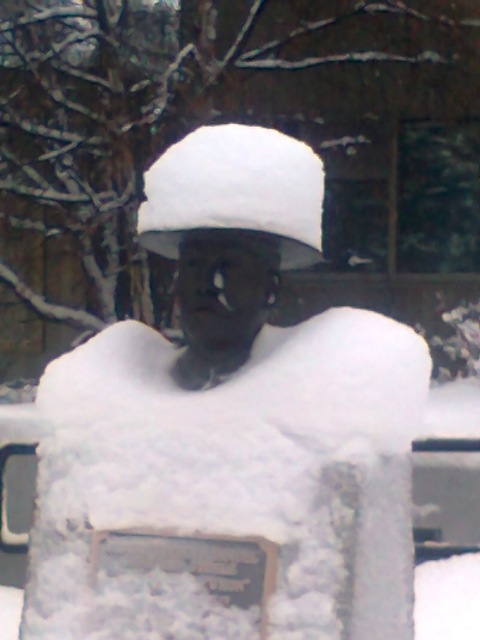
Poor old Sammy Steele, freezing year after year in his NWMP uniform. I like the fluffy cover for his mountie hat and his padded shoulders. But he looks sad, frozen tears on his cheeks. Will anybody out there have some mercy on him and other characters in the streets of Whitehorse? Jack London and Robert Service look cold, too!
“Walking Home – A contemplative journey along the Yukon River” is a short film conceptualized, directed, and produced by Othmar F. Arnold, with feedback and support from Celia McBride; filmed in Whitehorse, Yukon (Canada).
(All mentioned documents are linked directly to the original source.)
The preamble to the new strategy document outlines very nicely what a better Yukon for all means: “A socially inclusive society is one where all people feel valued, their differences are respected, and their basic needs are met so they can live with dignity. It is a society where everyone has the opportunity to participate and to have their voice heard.’ (p. 8) And it continues with deep insight about social exclusion: it “is the result of barriers in the social, economic, political and cultural systems” (p. 8).
In the introduction, the scope of the strategy is presented as a guideline to social policy development; or in other words, how government will facilitate a way of meaningfully living together. From the research the government conducted, it concluded that service delivery and access to services appear the main reasons for the fact that some people in the Yukon do not feel included. Furthermore, “poverty is one of the most obvious factors contributing to social exclusion, but social exclusion also stems from and is exacerbated by inadequate education, housing, health, social participation, employment and access to services (p. 8)”.
The Government of Yukon has recently released its long-awaited
Social Inclusion and Poverty Reduction Strategy
It has been in the works for a while and there were several delays in releasing the document. But I am glad that it has finally seen the light. The entire strategy document can be downloaded from the following page: A Better Yukon. On the same page, the government released the 2010 background research report: Dimensions of Social Inclusion and Exclusion.
A socially inclusive society is one where all people feel valued, differences are respected and basic needs are met so they can live with dignity. Barriers in social, economic, political and cultural systems can prevent people from being part of their community. Everyone is affected by social exclusion and poverty, and everyone plays a role in finding solutions.
Vision
A Yukon where social exclusion and poverty are eliminated, diversity is celebrated, and all Yukoners have the opportunity to prosper and participate to their full potential, free from prejudice and discrimination.
The strategy document provides guiding principles, goals, and a commitment to measure success.
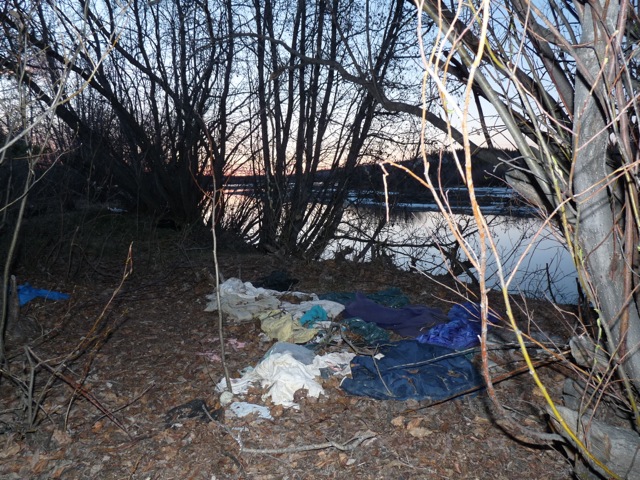
Evidence of Homelessness in Whitehorse: abandoned camp along the Yukon River






 OFRADIX