Ein treuer Wegbegleiter im Entlebuch – A forest spirit manifesting itself in the Entlebuch valley and watching over the trail.
After a full week of sharing life with the Sunnehuegel community, it was time for me to break camp and to start breaking trail again. After a hearty breakfast, I left in subzero temperatures with overcast skies. The last days, the sun tried to break through the clouds and the fog, but today grey was the main colour hue in the landscape of the Entlebuch.
I followed the hiking trail along the Little Emme River. In the vicinity of the towns, there were recent footprints in the snow. On the more remote sections, I followed the animal tracks, mostly fox and some deer. There were a few raptors perched in the trees along the river. It was quiet and peaceful. The river is following its course through the narrows and the wider sections with riparian habitats, surrounded by rocky outcrops that are decorated with curtains of icicles.
I need that distance and solitude in order to start processing the impressions gained during the previous week. The former monastery is a solid shell, a firm framework for community life. It becomes palpable very quickly, how these walls, the architecture separates the wider world from the more insular world of the Sunnehuegel community. Continue reading “Aufbruch – Departures #4”→
Invite somebody to read - Lade jemand zum lesen ein:
Bei der Ankunft im ehemaligen Kapuziner Kloster, dem heutigen Haus der Gastfreundschaft, ist eine grosse, steinerne Gedenktafel sichtbar. Obwohl die Tafel in erster Line auf die Baugeschichte des historischen Gebäudes verweist, lässt sich aus dem ersten Satz viel Vorgeschichte heraus lesen:
„Zur Beruhigung der bitteren Untertanen schickte nach dem Bauernkrieg von 1653 der Rat von Luzern die Kapuziner nach Schüpfheim und erbaute ihnen auf eigene Kosten hier, wo bisher ein Galgen mit Überresten hingerichteter Bauernführer stand, Kirche und Kloster.
Der Bauernkrieg war ein Aufstand der rechtlosen Landbevölkerung. Die Bauern hatten genug von der politischen Bevormundung und der wirtschaftlichen Ausbeutung und Benachteiligung durch die mächtigen Stadtherren. Continue reading “Ausgrenzung, Unterdrückung, und Widerstand (+en)”→
Invite somebody to read - Lade jemand zum lesen ein:
Bergahorn, allein auf weiter Flur [in der Nähe des Kraftortes Heiligkreuz] – A solitary Great (or Sycamore) Maple tree [near Heiligkreuz, a place of strength in Switzerland].
Heute möchte ich ein Gebet mit dir teilen, das in poetischer Weise beschreibt woher einige meiner Gedanken stammen die die Grundlage sind für viele meiner Blogeinträge. Es gibt mir Kraft, diesen Weg weiter zu gehen.
Gott,
lege Worte mir in den Mund,
die über das hinaus reichen, was erreichbar ist.
Die über das hinaus denken,
was denkbar ist.
Die sich mehr wünschen
und mehr vorstellen,
als ich mir wünschen und vorstellen kann. Continue reading “Verdichten (+en)”→
Invite somebody to read - Lade jemand zum lesen ein:
Located on a sunny hill in the middle of a rural town in the Entlebuch valley: “Haus der Gastfreundschaft” – The Hospitality House. – Auf einem sonnigen Hügel, eingebettet ins ländliche Dorf im Entlebuch: Das Haus der Gastfreundschaft.
It was the most beautiful day to arrive in Schüpfheim. Or as the Swiss would say: It was a weather like on a postcard. Brilliant sunshine and deep blue sky over a snow-covered landscape. I fully understand all the families that got the skis out of their basements or attics to make a few runs down a hill!
Once at the former monastery, one of the first sights was the reflection of the stained glass windows on the wall of the refectory. Open arms and a welcoming atmosphere. Continue reading “Ankunft – Arrival #3”→
Invite somebody to read - Lade jemand zum lesen ein:
A green heart for all the lovers of the world. Black River Gorges National Park, Mauritius. – Ein grünes Herz für alle Liebenden dieser Welt. Im Black River Gorges National Park auf Mauritius.
Invite somebody to read - Lade jemand zum lesen ein:
Turbocharged with the cherry juice from the orchards of my hosts (Cherryfarm Bakkershof in Brustem) and the memories of the eccentric gifts of the historic Christina, who was born in this very place, I set out into a warm and grey mid-winter day. 13 degrees Celsius, I need to dress down significantly!
The showers were frequent throughout the day. As I walked along the trail, I started to understand why the oldest settlements were in locations that we would call ‘holes’: These depressions are a natural protection from the strong winds that happen to blow frequently in this flat landscape. If it weren’t for the many groves and rows of sheltering trees, it would feel like on the islands in the Canadian Arctic.
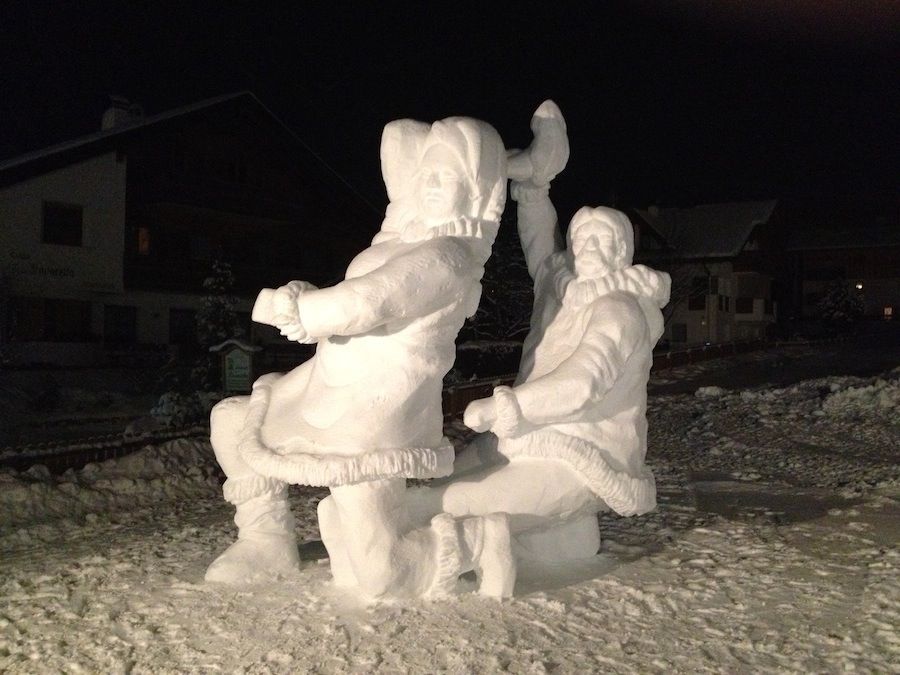
The Brave Hunter and the Walrus – Team Canada (photo credit: Donald C. Watt/snowcarver.ca)
The Brave Hunter and the Walrus
There once was a brave hunter who harpooned walruses to feed his village. This hunter would travel far out on the ice flows to where the giant walruses like to sun themselves. Once when hunting, he harpooned a giant walrus and was pulling it in when the walrus lunged forward to attack the brave hunter. At the same time the wife of the walrus came rising up under the ice flow the brave hunter was standing on trying to safe her husband.
Der Tapfere Jäger und das Walross
Es war einmal ein tapferer Jäger der Walrosse harpunierte um sein Dorf zu ernähren. Dieser Jäger reiste weit auf die Eisschollen hinaus, wo sich die riesigen Walrosse gerne sonnten. Auf einer dieser Jagden harpunierte er ein riesiges Walross und zog es zu sich hin. Da stürzte sich das Walross vorwärts um den tapferen Jäger angreifen. Zur gleichen Zeit kam die Frau des Walross an die Oberfläche von unterhalb der Eisscholle, auf der der tapfere Jäger stand, um zu versuchen ihren Mann zu retten.
Il Cacciatore Coraggioso e il Tricheco
C’era una volta un cacciatore coraggioso che arpionava trichechi per nutrire il suo villaggio. Questo cacciatore viaggiava lontano sul ghiaccio fino alla località, dove i trichechi giganti prendevano il sole. Una volta, il cacciatore aveva arpionato un tricheco gigante e lo stava tirando verso lui, quando il tricheco si lanciò in avanti per attaccare il cacciatore coraggioso. Allo stesso tempo, la moglie del tricheco si avvicinava da sotto il ghiaccio marino che il cacciatore coraggioso era in piedi, per provare a salvare suo marito.
First place Snow Festival in San Vigilio 2013:
Sister Sun and Brother Moon – Team Canada (photo credit: Donald C. Watt/snowcarver.ca)
Sister Sun and Brother Moon
A long time ago when the only light in the world was fire, the people lived in large round houses. In one such house a brother would always chase his sister around the fire. One time, while running around the fire, the sister grabbed up a brightly burning stick and headed outside the house to escape her brother, but brother then grabbed a small twig that burned less bright and ran out after her. They ran around and around the house but brother could not catch sister. They kept on running until they realized they were running across the sky. Sister’s brighter fire became the sun and Brothers dimmer light became the moon. Today you can still see Sister Sun and Brother Moon running circles across the sky.
Schwester Sonne und Bruder Mond
Vor langer Zeit, als das einzige Licht in der Welt Feuer war, lebten die Menschen in großen, runden Häusern. In ein solches Haus rannte ein Bruder immer seiner Schwester um das Feuer herum nach. Einmal, während dem sie um das Feuer herum lief, packte die Schwester einen hell brennenden Stab und ging aus dem Haus, um ihren Bruder zu entkommen. Der Bruder aber dann packte einen kleinen Zweig, der weniger hell brannte, und lief ihr nach. Sie liefen im Kreis um das Haus herum, aber der Bruder konnte nicht die Schwester nicht fangen. Sie rannten bis sie erkannten, dass sie am Firmament gingen. Das helle Feuer der Schwester wurde die Sonne und das schwächere Licht des Bruders wurde der Mond. Noch heute kann man sehen wie Schwester Sonne und Bruder Mond am Himmel kreisen.
Sorella Sole e Fratello Luna
Molto tempo fa, quando l’unica luce del mondo era il fuoco, la gente viveva in grandi case rotonde. In una casa un fratello avrebbe sempre inseguire la sorella intorno al fuoco. Una volta, durante il giro intorno al fuoco, la sorella ha afferrato un bastone luminoso ardente e si diresse fuori la casa per sfuggire al suo fratello, ma lui poi afferrò un piccolo ramoscello che bruciava meno brillante e corse dietro. Correvano intorno e intorno alla casa ma fratello non poteva prendere la sorella. Hanno continuato a correre fino che essi sono reso conto che corrono attraverso il cielo. Il fuoco brillante della sorella divenne il sole e la luce del fratello divenne la luna. Oggi è ancora possibile di vedere la Sorella Sole e il Fratello Luna giranti attraverso il cielo.
Invite somebody to read - Lade jemand zum lesen ein:
Die Kathedrale von Antwerpen – the cathedral in Antwerp
Many old brick buildings in Antwerp have survived time and the wars. But they do not shine like in the glory days of this port city.
This is not the cathedral: It is the central railway station. Belgium was not always a marginal region within the EU. For some decades, it was mingling among the colonial powers of the world.
Witness to the hidden sources of past wealth and affluence: The stately Congo Trading Post on the waterfront. There are no more commercial docks along the riverfront in the old city. The ship all land in modern docks in the industrial port north of the city.
The former glory still reflects in the puddles of the streets and lanes that leave a strong melancholic, if not depressing impression on the visitors.
The consequences of various crises are highly visible. Some of the prominent buildings are being restored and maintained with money from the European Union, while other, more humble ones are abandoned or have disappeared completely.
The grave of the unknown refugee. A unique monument to acknowledge the many refugees from all over the world that never make it to the Western world on their quest to escape social injustice and to seek a better life in the affluent parts of the world.
De Begijnhof in Antwerpen. This is a unique settlement within the city. It housed until 1986 a community of Beguines. Now it is a secular residential complex, maintaining the peace and quiet of its history.
Another view of the Béguinage in Antwerp. The small houses in this walled court were built to accommodate women who chose to live a religious life outside of a monastery with a strong communal sense.
Invite somebody to read - Lade jemand zum lesen ein:
Google Map mit dem ungefähren Kurs den wir auf der MV Rickmers Shanghai zurückgelegt haben. – The approximate route of the MV Rickmers Shanghai January 2013 transatlantic crossing.
Hier ist eine Kopie meines Reisetagebuchs von der Überfahrt (in Englisch). I have attached a copy of my ship diary.
Ship Diary:
January 13, 2013
Late this afternoon, I called the agent for the shipping company to confirm the departure time for the vessel. He said he was very glad that I called: The ship is expected to leave very early in the morning. Originally, departure time was estimated to be between noon and 6 o’clock. He kindly asked me to make my way to the marine terminal and check-in tonight.
Yesterday, I had the good luck of making another journey, within the city of Philadelphia. Through a friend of a friend, I received an invitation for dinner with strangers. But there was nothing strange about meeting the people I have never met before.
Except that I took a bus to get to the railway station, which is not so strange, but the bus followed the trolley lines. And except that the railway station was full of books, and the railway was long ago replaced by a suburban trolley. Had I spent browsing through the 50,000 books at the railway station, I could have found one that would explain the transportation history of Philadelphia and how the traffic patterns have changed over time.
After all, I was close to where the former summer White House was. Before the capitol was built in Washington, the government governed from Philadelphia, but when it was too hot and the mosquitos were too fierce, the government went up the hill to Germantown to conduct its business. And not far from the centre of power, a few German immigrants and Quakers were so upset about witnessing the everyday business of slavery, that they wrote a letter of protest to the government.
I consider myself blessed for the friendship and hospitality I received. It also gave me opportunity to experience some places of United States history along the way. And if you ever desire a used book on history or any other subject, feel free to check out the online section of the bookstore at the railway station.
Invite somebody to read - Lade jemand zum lesen ein:
When I think about the extent of misery I described in “Mapping it out”, there are many questions that come up for me:
When is this misery, this crisis going to end? This statement implies where we generally see the problem: The misery of “poverty amidst prosperity” seems to be the apparent problem that needs to be addressed. Why else would we find evidence of hundreds of charities and social services initiatives, both from the public and the private sector in Kensington?
Poverty is not the problem – Affluence is!
The early church fathers (5th century) have formulated it this way: “Some people are indigent for the very reason that others hold a superfluity. Take away the rich man and you will find no pauper. No one should own more than is necessary but everyone should have what they need. A few rich people are the reason why there are so many poor” (Pelagius, as cited by Wallis, p.116)
There is nothing wrong with wealth in its original meaning of the word: Being well. But affluence has nothing to do with well-being.
Affluence in the United States refers to an individual’s or household’s state of being in an economically favorable position in contrast to a given reference group.” (Wikipedia)
Jim Wallis describes how that dynamic of maneuvering into a favourable position for individuals, households, or corporations has led to a rat race that is ultimately destructive for the world. We seem to have lost some old fashioned values, like the concern for the common good. It is a sense of individual entitlement (“it’s all about me!”), and the instant gratification of wants (“and I want it now!”) that has taken over.
And we are not satisfied if we have all we need: The consumerist discourse suggests that we need to compete and get ahead of everybody else. Keeping up with the Joneses is one of the symptoms of affluenza, a non-medical disease that has become widespread in affluent societies:
Af-flu-en-za n. 1. The bloated, sluggish and unfulfilled feeling that results from efforts to keep up with the Joneses. 2. An epidemic of stress, overwork, waste and indebtedness caused by dogged pursuit of the American Dream. 3. An unsustainable addiction to economic growth.”(http://www.pbs.org/kcts/affluenza/)
Wallis describes how the market has become like a god. It is all-powerful, all-knowing, and all-present. We have subjected ourselves to the power of the market forces to the point where we start realizing and suffering from the symptoms of affluenza: This unfulfilled feeling.
However, the market does not give you the comfort of the divine. It is not all-loving. If we feel unfulfilled, the market will produce yet another consumable for us and will give us the promise that everything will be taken care of. It sounds like providence
Kensington is a prime example of the hollowness of that market providence. It is not meant to be shared among all human beings. It is not meant to be shared for the sustained well-being of all of creation. Most of us are aware that natural resources are limited. We have made everything on this planet and beyond a commodity that can be exploited for short term gain. Few decisions are driven by the concern of the seventh generation from now.
A perpetual and unregulated growth society needs millions of impoverished and middle-class people that sacrifice themselves and contribute to the extreme accumulation of wealth by a few. Wallis gives stunning examples of the growing gap between the rich and the rest in America and the world. The 400 wealthiest people in the United States control more assets than the 160,000,000 people at the bottom end of the wealth spectrum together!
And the gap is widening every year. That is why I am convinced that poverty is not the problem. Once we rediscover that we are happier with less, and that we are all in this together, we will be heading towards a state of providence. If we redesign our economy and polity, as an expression of the divine will, there will be enough to meet the needs of every human being.
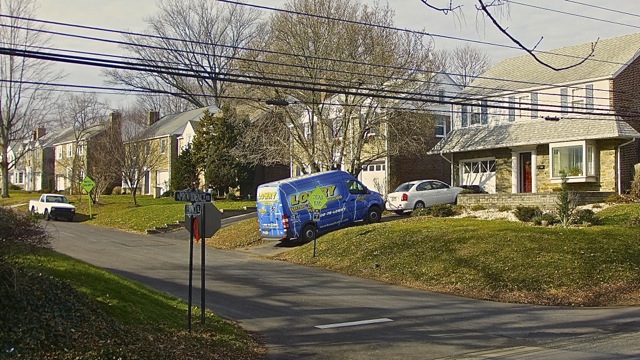
Street scene along Providence Road in Media, PA
In the meantime, the self-proclaimed “road to providence by perpetual and unlimited growth and consumption” is indeed a DEAD END. It has led to the financial collapse of recent years, and it will lead to further crises and catastrophes down the road.
Unless we decide to plan for de-growth and create a culture of sharing, we will have to ask ourselves again and again: when will this misery going to end? Wallis suggests that we better start with the question: “How is this crisis going to change me?”
The eerie beauty of the flashing lights from emergency response vehicles.
I have not met my neighbours, yet. But I have a variety of impressions from living side by side, separated by a wall that is not sound proof.
So far, I have heard only adult voices. There is no other indication that children are living right next door. People come and go. At times, the light is on in the dining room, whose windows are facing the windows of our dining room, six feet apart. Behind the curtains, outlines of human figures are visible. And these figures talk, discuss, and laugh. I consider the interactions animated, loud, passionate, Mediterranean.
In the flow of these voices, I can hear the door open and close, the conversations being carried out onto the street and slowly disappearing. Then it is silent, the light sometimes on, sometimes off.
I purchased oil and vinegar in one of the supermarket-like grocery stores in Kensington that clearly markets to the Caribbean immigrant community. I was standing out like a streetlight, not only by appearance, but also by language.
It was a busy store, or maybe just a busy time of the day. Couples and multi-generational teams were filling up grocery carts with exotic fruit and vegetables, with dry goods, cans, and fresh meat.
When I got to the lines at the check-out, the other customers took pity on me: They asked me first, and then they insisted, that I go right to the front of the line with my two small items for purchase.
I had all the time in the world to wait my turn like everybody else since I was simply out exploring the neighbourhood; but it was of little avail to explain that to the crowd that was discussing the case in multiple languages and came to the consensus that I should go first.
I expressed my gratitude for the gesture. It made me feel special, it made me feel welcome, and it gave me a sense of genuine community spirit.
Viva el Caribe!
Sharing the Root – Painting by Tenyoh (photo credit: Yoko Sugawara)
The row houses in the Kensington area were originally built for workers in the vicinity of the factories that employed them. They are a monument to industriousness and dignity. The factories were not social institutions, but apparently it was possible for many families to live in their own little house in the neighbourhood. It was a short commute to the workplace. There were many little corner stores selling things of daily needs, and bars for those who had daily or occasional wants. Some avenues were commercial districts with a variety of stores and shops. I have seen a library in a park, schools and a hospital – all in a similar architectural style making use of brickwork, just the way the factories were built. And there were many churches to comfort the ones hit by hardship and to celebrate with the ones who were able to make it.
Industrial Beauty – a restored factory portal in Kensington
The Kensington neighbourhood might be one of the rougher places in Philadelphia – the City of Brotherly Love.
There must be a way…
Allegheny Station of the subway system is not particularly accessible. The trains are running elevated at the level of the third and fourth story of the adjacent houses. The station exit is not fitted with an elevator – just long concrete stairs down to street level, moist and slippery from the melting snow mixed with the grime of an administrative district with low-priority for proper maintenance. Continue reading “Daily Random Act of Kindness #3”→
Invite somebody to read - Lade jemand zum lesen ein:


![Bergahorn, allein auf weiter Flur [in der Nähe des Kraftortes Heiligkreuz] - A solitary Great (or Sycamore) Maple tree [near Heiligkreuz, a place of strength].](https://ofradix.net/wp-content/uploads/2013/02/sunnehuegel6.jpg)








 OFRADIX