An exploration of roots and what is growing from them
Category: Simplicity – Einfachheit
“At the center of our being is a point of nothingness which is untouched by sin and by illusion, a point of pure truth, a point or spark which belongs entirely to God, which is never at our disposal, from which God disposes our lives, which is inaccessible to the fantasies of our own mind or the brutalities of our own will. This little point of nothingness and of absolute poverty is the pure glory of God in us… It is like a pure diamond, blazing with the invisible light of heaven. It is in everybody, and if we could see it we would see these billions of points of light coming together in the face and blaze of a sun that would make all the darkness and cruelty of life vanish completely…I have no program for this seeing. It is only given. But the gate of heaven is everywhere.”
Thomas Merton, Conjectures of a Guilty Bystander, 1968
.For more of my own writing related to the above quote, please follow the links below:
How often do we portray traditions as the solid anchors of cultural and societal systems? But how solid and powerful are they really?
Sure they provide us comforts. Like our own family Christmas celebrations: We moved from Switzerland to the Yukon and ended up living on the margins of First Nations villages for many years. Because our children were young, we started to celebrate Christmas – something I have rejected doing in my young adult years.
The only tradition that we adopted for the Christmas holiday during those years was a late night visit to the barn on Christmas Eve. There we treated the farm animals with apples as a bedtime snack. The rest of the year it was hay and water. I never really understood whose tradition it was, but it suited my need to mark what perverted into a commercial holiday with something that was meaningful to me.
A simple message of peace.
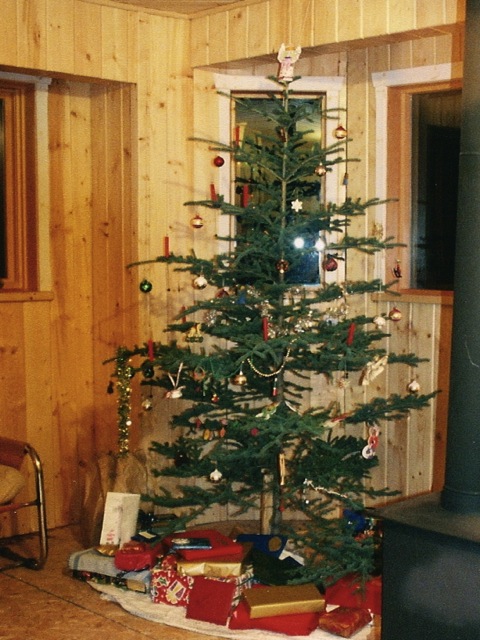
The first winter out in the bush in Canada we discovered that the family celebrations here happened on Christmas day, while our tradition was on Christmas Eve. To this day, we maintain the Swiss tradition and it feels right. Real tree, real candles. Ox and donkey became moose and caribou.
While living in the small remote communities, there was also a distinct advantage to having two different timing traditions for the festivities. I was always on call for a variety of emergency services. I got to turn off my radios on the 24th, while my colleagues of the British/North American and First Nations traditions took call. Then on the 25th, I took all calls while the turkeys and hams were roasting and being shared among families. That way, nobody had to miss his or her traditional celebrations due to an emergency response.
It is remarkable to see how our adult children, who grew up in Canada, to this day never questioned the diversity in tradition and seem to be comfortable being ‘outsiders’ in a world dominated by Santa Claus and electrified Christmas trees that get discarded the day after we decorate ours and light the candles for the first time! They hardly know the biblical story that has informed our and our ancestors’ understanding of Christmas; nonetheless, they are now adopting a unique form of a celebration that has a strong connotation to the concern for others, to light, to seasonal change, and thus solstice more than birth of Christ.
Peace to the World – Frieden auf Erden!
Sämtliche Traditionen haben einen Anfang, und alle Traditionen können und werden sich ändern.
Wie oft haben wir Traditionen als den festen Anker der kulturellen und gesellschaftlichen Systeme porträtiert? Aber wie solide und stark sind sie wirklich?
Sicher, sie bringen uns Trost. So wie unsere eigenen Weihnachtsfestlichkeiten in der Familie: Wir sind aus der Schweiz in den Yukon umgezogen und lebten am Rande der First Nations Dörfer für viele Jahre. Da unsere Kinder klein waren, fingen wir an Weihnachten zu feiern – etwas, was ich als junger Erwachsenen abgelehnt hatte.
Die einzige Tradition, die wir in jenen Jahren für die Weihnachtsfeiertage übernahmen, war ein nächtlicher Besuch im Stall am Heiligabend. Wir brachten den Tieren Äpfel als Feiertagsschmaus. Den Rest des Jahres gab es Heu und Wasser. Ich habe nie wirklich verstanden, wessen Tradition es war; aber es deckte mein Bedürfnis einen Tag im Jahreszyklus bedeutungsvoll zu markieren, welcher ansonsten in einen kommerziellen Festtag pervertiert wurde.
Eine einfache Botschaft des Friedens.
Den ersten Winter draußen im Busch in Kanada haben wir entdeckt, dass die Feierlichkeiten hier am Weihnachtstag angesagt sind, während unsere Tradition auf den Heiligabend fällt. Bis zum heutigen Tag erhalten wir die Schweizer Tradition und es fühlt sich so richtig an. Einen echten Baum, mit echte Kerzen. Der Ochse und der Esel wurden zum Elch und dem Karibu.
Die zwei unterschiedlichen Zeitpunkte für Festtagstraditionen hatten in den kleinen abgelegenen Gemeinden auch einen deutlichen Vorteil. Ich war immer auf Abruf für verschieden Notfalldienste. So konnte ich am 24. meine Funkgeräte abschalten, weil meine Kollegen von den britischen / nordamerikanischen und First Nations Tradition auf Piket waren. Dann am 25. übernahm ich Bereitschaftsdienst während die Puten und Schinken gebraten wurden und die Familien feierten. So musste niemand seine traditionellen Festlichkeiten wegen eines Notrufs verpassen.
Es ist bemerkenswert zu sehen, wie unsere erwachsenen Kinder, die in Kanada aufgewachsen sind, bis zum heutigen Tag die Vielfalt der Traditionen nie in Frage gestellt haben. Sie scheinen zufrieden zu sein mit ihrem `Aussenseiter´ Status in der von Santa Claus und elektrifizierten Christbäumen dominierten Umgebung. Die Christbäume werden hier am Tag nachdem wir unseren schmücken und die Kerzen zum ersten Mal entfachen, weggeworfen.
Sie sind kaum vertraut mit der biblischen Geschichte, die unser Verständnis und das Verständnis von Weihnachten unserer Vorfahren geprägt hat; dennoch haben sie nun diese eigenartige Form der Feierlichkeiten übernommen, als etwas das einen starken Bezug zur Sorge für Andere hat; etwas das sich aufs Licht und die saisonalen Veränderungen und damit der Wintersonnenwende mehr bezieht als auf Christi Geburt.
Peace to the World – Frieden auf Erden!
Invite somebody to read - Lade jemand zum lesen ein:
For the third time in my life, I have become co-owner of a bank. This seems like a contradiction for a person who embraces voluntary poverty, strives for a simple life, aspires to the ideal of non-possession. Well, I call it a necessity on the way.
The meaning this step has for me is the reason why I feel led to share this unspectacular event in a person’s life with you. I am very critical of the consumerist-capitalist paradigm and dominant economic system. I am deeply suspicious about the integrity of the banking system. These banking institutions embody much of what I see is missing the mark in the global discourse of affluence.
Intriguing pattern of light – Art installation by Niki Saint Phalle in the historic grotto at the Royal Herrenhäuser Gardens in Hannover, Germany
Merci à Marie Villeneuve du Radio Canada de Vancouver. Elle m’a appelée cet après-midi pour une entrevue pour le Boulevard du Pacifique, une nouvelle émission radio d’après-midi où se croisent des réflexions et des découvertes sur notre société et ses cultures.
J’ai parlé avec elle des statues au centre ville de Whitehorse, Yukon qui sont au froid pendant l’hiver. J’ai remarqué qu’ils sont tristes, avec des larmes de glace sur ces visages. Personne a pitié ces personnage historique quand il fais les -35 degrés au Yukon. Alors, j’ai lancé un appel pour décorer les statues de la même façon que l’avion à l’aéroport de Whitehorse en août passé. « Yarn bombs needed » veut encourager tous les tricoteurs et tricoteuses du Yukon de créer des vêtements d’hiver artistique pour les statues de Sam Steele, Jack London, Robert Service et autres.
Good old Jack London looks much happier and warmer already!
As we were gathered in silence this Sunday, it was easy to listen to and to hear the raindrops outside.”
The reference to rain shows that I wrote this account of my thoughts back in October when I was worshipping with the Victoria Friends Meeting – here in the Yukon it is currently -35 degrees and no rain in sight!
I was contemplating on the various ways they follow their journey in their natural cycle. Some of them will fall on the earth, the ground that is receptive to soak them up, to store it for the plants, and to release it in the cycle later. Others will run off and pool in a depression, being available for animals to quench their thirst. Yet others will fall on a roof, go down the gutter, onto the concrete, run off the roadways, into the sewer system and the storm drains. Some of them will need to go through a water treatment plant before they are released back into the wild, allowing them to join the natural cycle again.
(All mentioned documents are linked directly to the original source.)
The preamble to the new strategy document outlines very nicely what a better Yukon for all means: “A socially inclusive society is one where all people feel valued, their differences are respected, and their basic needs are met so they can live with dignity. It is a society where everyone has the opportunity to participate and to have their voice heard.’ (p. 8) And it continues with deep insight about social exclusion: it “is the result of barriers in the social, economic, political and cultural systems” (p. 8).
In the introduction, the scope of the strategy is presented as a guideline to social policy development; or in other words, how government will facilitate a way of meaningfully living together. From the research the government conducted, it concluded that service delivery and access to services appear the main reasons for the fact that some people in the Yukon do not feel included. Furthermore, “poverty is one of the most obvious factors contributing to social exclusion, but social exclusion also stems from and is exacerbated by inadequate education, housing, health, social participation, employment and access to services (p. 8)”.
The Government of Yukon has recently released its long-awaited
Social Inclusion and Poverty Reduction Strategy
It has been in the works for a while and there were several delays in releasing the document. But I am glad that it has finally seen the light. The entire strategy document can be downloaded from the following page: A Better Yukon. On the same page, the government released the 2010 background research report: Dimensions of Social Inclusion and Exclusion.
A socially inclusive society is one where all people feel valued, differences are respected and basic needs are met so they can live with dignity. Barriers in social, economic, political and cultural systems can prevent people from being part of their community. Everyone is affected by social exclusion and poverty, and everyone plays a role in finding solutions.
Vision
A Yukon where social exclusion and poverty are eliminated, diversity is celebrated, and all Yukoners have the opportunity to prosper and participate to their full potential, free from prejudice and discrimination.
The strategy document provides guiding principles, goals, and a commitment to measure success.
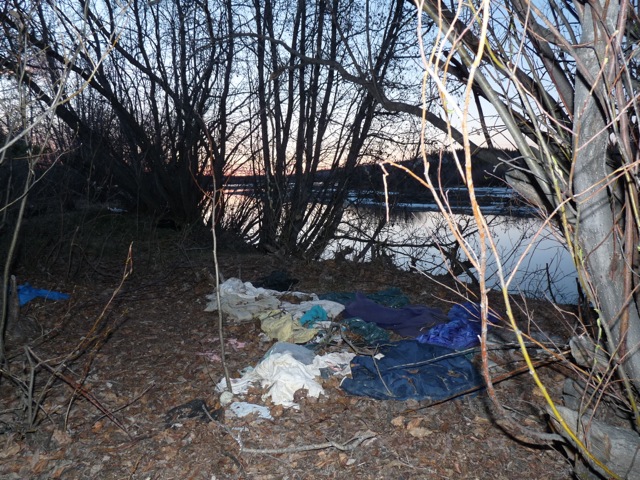
Evidence of Homelessness in Whitehorse: abandoned camp along the Yukon River
Dear Friends,
please enjoy and get inspired by this teaser film for a documentary called “LandFillharmonic” I found on an other blogsite. It is excellent evidence that we can make the best out of whatever we have, even if we have nothing!
“One day it occurred to me to teach music to the children of the recyclers and use my personal instruments,” explains 36 year-old Chávez, who worked as an ecological technician at the landfill. “But it got to the point that there were too many students and not enough supply. So that’s when I decided to experiment and try to actually create a few.”
Working beside the families for years Chávez eventually made friends and became acutely aware that the children needed something positive in their lives. He was inspired to do something to help. He began using the trash in the landfill to create instruments for the children.
The town of Cateura was built virtually on top of a landfill. Situated along the banks of the Paraguay River, the landfill receives over 1,500 more tons of solid waste each day. There are seven different neighborhoods built around the landfill, accounting for over 2500 families living in close proximity to dangerous waste. Most of the families, including children, are employed by the landfill as recyclers. The poverty has forced children to work in the landfills, neglecting any education that might lead them to a better life. (from: artjournal.com)
It matches the powerful message of my own film project about community development, empowerment, and resourcefulness “Healing in Babalmé”. Watch the short film on YouTube or follow this link:
Community mobilization and health education during a malnutrition crisis in Babalmé/Chad
The following article has just been published this week in The Canadian Friend, 108(5) p.13 , a publication of the Canadian Yearly Meeting of the Religious Society of Friends. You can find the current and many back issues online: The Canadian Friend.
Médecins Sans Frontières / Doctors Without Borders in Chad
by Othmar F. Arnold
I have been asked: “How did this service work change me? What impact did the experiences have on my life?”
I must acknowledge that I have not been working as a nurse since that time. I am not the same person as before the mission. A major shift began in my life several years ago. I was called back to my roots, to become radical again, and there were other factors enabling a mid-life reorientation
My children were growing up and becoming more and more independent. Though the high-paying nursing work in Nunavut enabled me to liberate myself from financial obligations accumulated over the years, I was becoming less and less convinced by the direction nursing was going.
Healing in Babalmé – A story of hope from a marginalized place tells the story of a humanitarian worker’s lived experiences during a malnutrition crisis in Chad, where a pastoralist community on the edge of the Sahara desert mobilizes its own resources to overcome effects of marginalization. This short experimental documentary is a witness to the power of supportive non-intervention and true community development.
für eine deutsche Übersetzung klicke hier: Hoffnung in Babalmé
I am pleased to announce, that my creative spirits have persisted, thanks to the encouragement of Celia and others, to revise and re-edit the animated audio-visual presentation based on my experiences in Chad. I still feel blessed that I have been able to witness the events that inspired me to write the story. They are still a source of hope for me. The events illustrate for me that there is “that of God in everyone”: People with nothing can make a difference if we don’t crush their individual and collective agency with might and paternalistic intentions.
It will be another venue to share the message of hope with a wider audience.
You can enjoy the preview in this YouTube version anytime by clicking the arrow button:
Have you ever been frustrated by your bicycle commuting, especially in winter when the conveniently usable road surface starts to decrease due to accumulation of snow ploughed to the side of the road where two-wheeled commuters usually drive in absence of a designated bike trail system or bike lanes? Here is a tip that made an enormous difference for me:
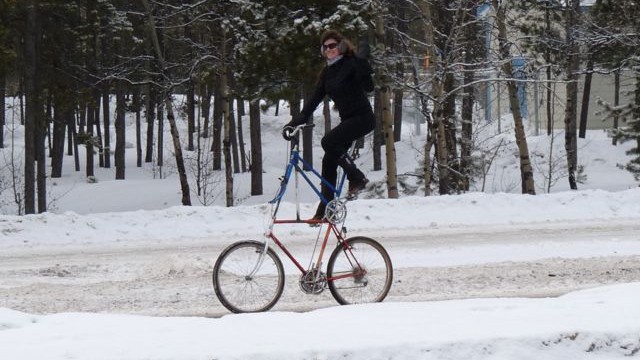
Bell testing the tall bike in Whitehorse on wintery roads.
Two winters ago, Australian penny farthing champion Bell Chamberlain visited Whitehorse and the Yukon Territory. She inspired us to build a tall bike from old bicycle parts that were lying around in the back yard. Merci beaucoup, Philippe! No it was not pretty, but it quickly became a head turner in Whitehorse.
“Hope on the Horizon” screenshot from the online version of the MSF Canada magazine Dispatches 16(2), Summer 2012
I still remember my first visit to Babalme in July 2011. The MSF vehicle had to use a local guide to point at indistinguishable features on the horizon, a lone tree or a sand dune, to direct us more than twelve kilometers off the last known track in the desert sand. It was a bleak picture. The area was drier than the rest of the Sahel, not a single mud brick building, no school, no health centre – just people living a pastoralist life in a forgotten corner of Chad and close to the border with Niger.
Otmar wuchs wahrscheinlich in einer angesehenen alemannischen Familie am Bodensee auf. Er wurde dort auch geschult und später nach Chur zum Studium geschickt. Nach der Priesterweihe wurde er im Pfarreidienst eingesetzt. Im Alter von dreissig Jahren wurde er beauftragt im Steinachtal bei der Zelle des Gallus ein Kloster zu errichten.
Otmar hatte eine ausgeprägte soziale Ader, verschenkte Klostervermögen an die Armen, baute in der Nähe des Klosters das erste Haus für Aussätzige in der Schweiz und nahm Kranke, Blinde und Arme in einem weiteren Bau auf, wo er sie auch nachts selbst betreute; die enge Verbindung der Klosterbrüder zum einfachen Volk begründete Missionserfolge und brachte ihm den Namen Armenvater ein. Er fürchtete den wachsenden Reichtum seines Klosters und kleidete sich selbst einfach, ritt nur auf einem Esel statt auf einem Pferd. (Ökumenisches Heiligenlexikon)
“At the center of our being is a point of nothingness which is untouched by sin and by illusion, a point of pure truth, a point or spark which belongs entirely to God, which is never at our disposal, from which God disposes our lives, which is inaccessible to the fantasies of our own mind or the brutalities of our own will. This little point of nothingness and of absolute poverty is the pure glory of God in us… It is like a pure diamond, blazing with the invisible light of heaven. It is in everybody, and if we could see it we would see these billions of points of light coming together in the face and blaze of a sun that would make all the darkness and cruelty of life vanish completely…I have no program for this seeing. It is only given. But the gate of heaven is everywhere.”







 OFRADIX