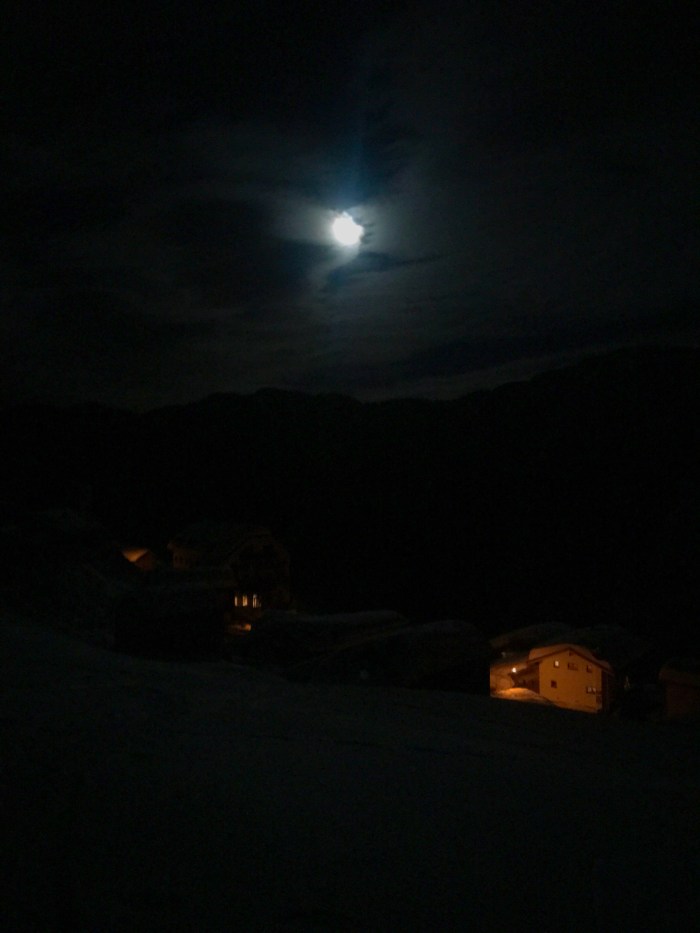
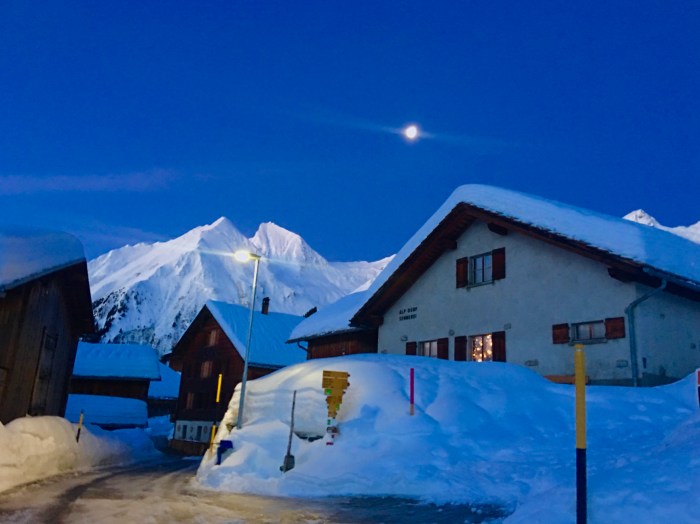
Eine helle Mondnacht lud heute ein zum Nachtskifahren am Solarskilift (interessanterweise funktioniert der auch bei Mondenschein!), zu nächtlichen Schneeschuhtouren auf das Tenner Kreuz, oder einfach zum Verweilen und Betrachten der Ruhe und Stille im Luft- und Höhenkurort Tenna.
Tonight we had ideal conditions to do some moonshine skiing at the solar-powered ski lift (which seems to work just fine at night!), or to a nighttime snowshoe trek to the Tenner Kreuz viewpoint, or to simply sit back, relax, and enjoy the peace and quiet in Tenna high above the Safien Valley.
The rest of the world, at least according to the news media, was obsessing over the super-blue-blood moon and the lunar eclipse that was not visible from here. Is it no longer possible for us human beings to simply appreciate beauty when it presents itself; to enjoy a night with a full moon, simply because the local conditions invite to do so?
Der Rest der Welt, wenigstens in den Medien, ereiferte sich über den Super-Blue-Blood Mond und die von hier aus nicht sichtbare Mondfinsternis. Ist es heute nicht mehr möglich, Schönheit zu erkennen, wenn sie sich präsentiert; eine Vollmondnacht zu geniessen, weil die örtlichen Bedingungen dazu einladen?
Invite somebody to read - Lade jemand zum lesen ein:
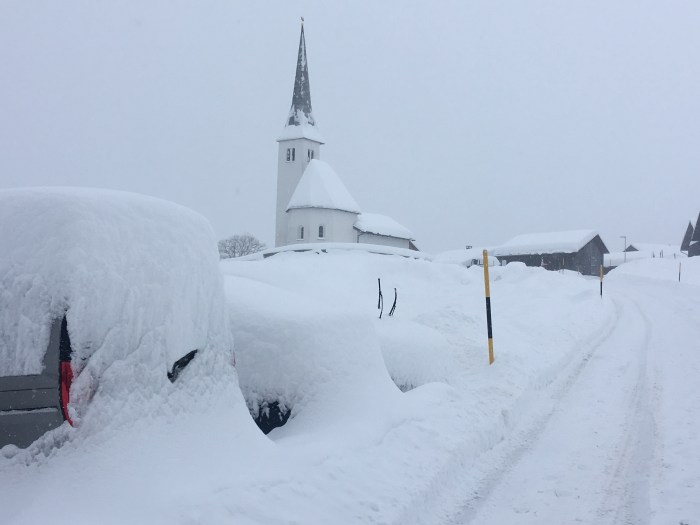
Grüsse aus Tenna, das seit heute Nachmittag wegen grosser Lawinengefahr von der grossen weiten Welt abgeschnitten ist!
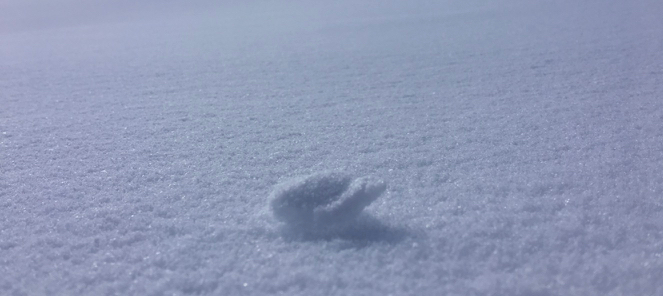
Schon vor ein paar Tagen habe ich diese Bild geknipst und mir gedacht, dass die grossen Schneefälle den Einheimischen und den Gästen die Gelegenheit geben, es ruhiger und gemütlicher zu nehmen. Nun brauchen wir uns definitiv keine Gedanken zu machen über Termine und Verpflichtungen da draussen…
Greetings from Tenna! As of this afternoon we have no road connection to the outside world due to the high avalanche danger.
A couple of days ago I took the above picture, thinking that these heavy snowfalls give the villagers and guests the opportunity to take it easy and more relaxed. Now, there is absolutely no need anymore to worry about appointments and commitments in the “outer world”…
Update:
Safierstrasse – our highway…, 4. Januar 2018 (photo credit: Thomas Buchli)
Update 2: Nach dem Sturm – after the storm!
“Vollmond” in eisiger Nacht – A full moon over frozen ground (January 5th, 2018)
Invite somebody to read - Lade jemand zum lesen ein:
An den kurzen Tagen im Advent wird jeden Tag ein Lichtlein mehr in unser Dorf gebracht. Die Landfrauen von Tenna laden alle Bewohner und Gäste wie jedes Jahr ein, sich auf einem stimmungsvollen Adventsspaziergang an den vielen Adventsfenstern im Dorf und den Fraktionen zu erfreuen.
Für diejenigen, die keine Gelegenheit selber von Haus zu Haus zu gehen in Tenna, hier eine Zusammenstellung der verschiedenen Beiträge; klick auf die Bilder um sie grösser zu sehen.
24. Dezember: Tanja & Thomas Buchli-Zysset bim wysse Huus
19. Dezember: Margrit & Josi Messmer-Thöny ob dr Ruchegga
15. Dezember: Bigna & Simon Zellweger z’innerscht am Innerberg
12. Dezember: Marianne & Richard Messmer-Buchli am Innerberg
2. Dezember: Ursula & Daniel Tanner-Höfliger am Innerberg
23. Dezember: Käthi & Michel Buchli-Weber uf der Mitti
3. Dezember:
5. Dezember: Claudia & Walter Kessler-Becker bim Althus
Susanne & Reto Gartmann-Wunderle bim Stützli
18. Dezember: Barla Tscharner im Chirchehus
10. Dezember: Petra Bürgler im Pfruondhus
22. Dezember: Ursi & Michel Pöhl-Messmer am Innerberg
13. Dezember: Elisabeth & Jakob Bardill-Meyer am Höhport
6. Dezember: Dorfladen Volg Tenna
4. Dezember: Monika & Christian Eggenberger bim Riedhus
14. Dezember: Maya & Alexander Messmer-Blumer am Innerberg
16. Dezember: Elvira & Martin Juon z’underscht am Innerberg
9. Dezember: Silvia & Johann Joos-Lötscher uf der Hofstatt
1. Dezember: Primarschule Tenna
17. Dezember: Anni Messmer am Innerberg
8. Dezember: Barbara & Stefan Joos-Zwander uf der Hofstatt
7. Dezember: Elsbeth & Michel Bandli-Juon bim Neuhus
11. Dezember: Silvie & Martin Schaufelberger-Mösch bim Oberhus
20. Dezember: Alte Sennerei (Verein Tenna Hospiz)
Invite somebody to read - Lade jemand zum lesen ein:
“Gesang verschönt das Leben, ihn hat uns Gott gegeben.” Rückseite der Fahne von 1889 – “Singing makes life more beautiful, it was given to us by God.” – Reverse of the flag from 1889Fahne “Sänger Chor Tenna 1889” – Flag of the Choir of Tenna, 1889
Invite somebody to read - Lade jemand zum lesen ein:
“To err is human” – many people (of faith) are hardly aware how much they lean towards this human quality when they understand themselves as lifelong spiritual seekers on a path. Among Quakers, the idea of the “absolute perhaps” became established. It is expression for continuous divine revelation and the consequence thereof that we, as humans, can never exactly or definitely know, where truth lies – since God will eventually reveal us more. As it happened for millennia since biblical times.
Continuous revelation as a theological principle is being used today too often as justification for self-indulgent arbitrariness. Continue reading “To err is human”→
Invite somebody to read - Lade jemand zum lesen ein:
“Irren ist menschlich” – viele (gläubige) Leute sind sich heute wohl kaum bewusst, dass sie sich kräftig dieser menschlichen Qualität zuwenden, wenn sie sich als lebenslange spirituelle Sucher auf dem Weg verstehen. Bei den Quäkern hat sich eine Vorstellung des “absoluten Vielleicht” eingebürgert. Es ist ein Ausdruck dafür, dass sich Gott fortwährend offenbart und dass wir als Menschen nie genau oder abschliessend wissen können, wo die Wahrheit liegt – denn Gott wird uns noch mehr offenbaren. So wie dies über Jahrtausende seit der biblischen Zeit geschehen ist.
Diese theologische Grundhaltung der fortwährenden Offenbarung wird heute allzu oft als Legitimation für Beliebigkeit gebraucht. Continue reading “Irren ist menschlich”→
Invite somebody to read - Lade jemand zum lesen ein:
A meditative video on the transitioning from this world. Palliative Care and the hospice movement make it possible to live with dignity to the last moment. What lies beyond, remains a mystery – until then.
Ein meditatives Video zum Übergang von dieser Welt. Palliative Pflege und die Hospiz Bewegung ermöglichen es, bis zuletzt in Würde zu leben. Was uns jenseits erwartet, bleibt uns verborgen – bis dann.
.
.
In support of Tenna Hospice Association – zur Unterstützung des Vereins Tenna Hospiz.
Der Verein Tenna Hospiz wagt sich, auf Anraten der jüngeren Mitglieder, einen Teil der Finanzen um das Projekt Tenna Hospiz realisieren zu können, über eine Crowdfunding Kampagne zu sammeln.
Hier unser Trailer:
Für deutsche oder englische Untertitel, wechsle die Einstellungen am unteren Rand des Videos. for English or German subtitles, please choose from the settings bar.
Die Kampagne ist bei www.lokalhelden.ch aufgeschaltet. Wir suchen deine Mitarbeit: Erstens müssen wir rechtfertigen, dass die Kampagne auch gefragt ist. Das heisst wir müssen mindestens 100 Fans mobilisieren, die kund tun, dass sie die Idee und das Vorhaben wichtig finden. Erst dann wird die Finanzierungsphase frei geschaltet.
Also, auf geht’s:
www.lokalhelden.ch anwählen. Am oberen Rand ‘anmelden/registrieren’ anklicken. ‘Registrieren’ wählen in der Dialogbox.
Auf der nächsten Seite mit Name, einer E-Mail Adresse und einem Passwort registrieren.
Schön dass sie da sind: Lokalhelden schickt dir eine E-Mail mit dem Aktivierungs-Link. Im E-Mail ‘jetzt bestätigen’ anklicken.
Jetzt kommst du zurück auf http://www.lokalhelden.ch. Am oberen Rand wiederum ‘anmelden/registrieren’ anklicken. E-Mail Adresse und Passwort eingeben und ‘Anmelden’ wählen in der Dialogbox.
www.lokalhelden.ch/fundament-tenna-hospiz die Webseite des Projektes “Fundament Tenna Hospiz” anwählen und “Fan werden” drücken (oder sonst wie durchblicken mit Postleitzahl 7106…
wenn alles geklappt hat, erhöht sich die Zahl der Fans um 1! Bravo und ein herzliches Danke schön für deine Unterstützung.
Natürlich werden wir die Menschen, die uns unterstützen auch über den weiteren Verlauf der Kampagne informieren.
Es gibt natürlich auch viel Information zum Projekt und der Schwarmfinanzierung auf dieser Webseite.
The Tenna Hospice Association has initiated a crowdfunding campaign to boost the financing for the Tenna Hospice project. We are using a Swiss website, and the content is in German only. However, you can set English subtitles to our promotional video.
We need you: please register and log in at www.lokalhelden.ch, and become a fan of the project “A foundation for the Tenna Hospice”. We need at least 100 fans as soon as possible in order to start the actual funding phase of the campaign.
The crowdfunding platform will accept credit card payments. For other international donations, please contact the Tenna Hospice Association. There is a contact form on the website!
Working in Aboriginal Communities: What Kind of Health are we Promoting?
In this paper, I will explore the paradoxes and dilemmas embedded in intercultural health care practice. It is the intent of this work to reflect on theories and practices of Western-trained health care providers, consider the implications of our practice in an intercultural environment, and accept the invitation to the visitors on Aboriginal territory by Umeek to find guidance in scholarship from the world views as handed down over generations in First Nations creation stories (Atleo, 2004) to explore an Aboriginal understanding of health and health promotion.
Othmar F. Arnold, unpublished manuscript, University of Victoria BC, 2004
Individual beings are designed to help one another in order to fulfill the requirements of wholeness, balance and harmony, interconnection, and interrelationality. Therefore, to practice vanity as a lifestyle can be destructive. (Atleo, 2004, p. 35)
In the traditional Cree language of the Whapmagoostui, there is no word that translates directly into health (Adelson, 2000). In many Aboriginal worldviews, health is a desired state of the universe (Atleo, 1997). In our North-American context, it seems that health as an abstract and isolated concept that can be discussed and analyzed in a pure scholarly manner, a standard that needs to be achieved, is a phenomenon imported by the European colonizers of the continent. In the European tradition, physical and mental health are researched and discussed at least since the ancient Greek times. Since health is mostly defined as a state of physical and mental wellbeing, and therefore linked to the absence of disease and illness, it is associated with the biomedical sciences (Anderson & Reimer Kirkham, 1999). However, only within the last century was the medical profession successful in appropriating the definition of health and therefore dominating the health care system. Continue reading “Working in Aboriginal communities: What kind of health are we promoting?”→
Invite somebody to read - Lade jemand zum lesen ein:
The lettering “Alp-Dorf Sennerei” is still very legible on the wall of a rather inconspicuous building in Tenna, Switzerland. Prominently, it sits on the edge of the fraction Mitte, opposite the late-Gothic church, which gets all the attention. For many years, no more cheese has been produced here.
Noch ist der Schriftzug “Alp-Dorf Sennerei” gut lesbar an der Fassade des unscheinbaren Gebäudes in Tenna. Prominent sitzt es am Rande der Fraktion Mitte, gegenüber des spätgotischen Kirchleins, das alle Aufmerksamkeit kriegt. Käse wird hier schon länger nicht mehr hergestellt.
you're asking, how is the resurrection of the dead?

I do not know

you're asking, when is the resurrection of the dead?

I do not know

you're asking, is there a resurrection of the dead?

I do not know

you're asking, is there no resurrection of the dead?

I do not know

I only know, what you are not asking about:

the resurrection of the living

I only know, what he is calling us for:

to the resurrection in the here and now.

(Kurt Marti)
The last line of this poem by Kurt Marti could also be translated to: “to the standing up in the here and now”, to better convey the intended meaning from the multiple uses of the word “Auferstehung” in the German language.
Kurt Marti excelled in this poem once more in grounding complex metaphysical-religious concepts with simple phrases. He easily brings the reader back to everyday life. This is great inspiration to me.
Over the past few days, it became clear to me that I continue to be called to support those people in this world, who have difficulty to believe that there can be such thing as a resurrection of the living. These are no infidels and heathens; these are the excluded, the under-priviledged, the marginalized, those affected by the consequences of our wealth and security.
I made myself once more available for consideration for serving another mission with MSF/Doctors without Borders in the foreseeable future.
ihr fragt, wie ist die auferstehung der toten?

ich weiss es nicht

ihr fragt, wann ist die auferstehung der toten?

ich weiss es nicht

ihr fragt, gibt’s eine auferstehung der toten?

ich weiss es nicht

ihr fragt, gibt’s keine auferstehung der toten?

ich weiss es nicht

ich weiss nur, wonach ihr nicht fragt:

die auferstehung derer die leben

ich weiss nur, wozu Er uns ruft:

zur auferstehung heute und jetzt.

(Kurt Marti)
Kurt Marti hat es auch in diesem Gedicht geschafft, metaphysisch-religiöse Konzepte in einfachen Sätzen zurück auf den Boden der Alltagsrealität zu holen. Davon lasse ich mich gerne inspirieren.
Für mich ist in den letzten Tagen klar geworden, dass ich immer noch gerufen bin, diejenigen Menschen in dieser Welt zu unterstützen, denen es schwer fällt daran zu glauben, dass es eine Auferstehung der Lebenden geben kann. Nein, das sind keine Ungläubigen; sondern Ausgegrenzte, Unterpriviligierte, An-den-Rand-Gedrängte, Betroffene der Konsequenzen unseres Wohlstandes und unserer Sicherheit.
Ich habe mich deshalb wieder bei MSF/Ärzte ohne Grenzen gemeldet, um in absehbarer Zukunft durch einen Einsatz in einem ihrer Projekt zu dienen.
In der Kirche Tenna, Gemeinde Safiental, Schweiz, gibt es einen bemerkenswerten Passionszyklus. Dieser wurde im Jahr 1408 von einem unbekannten Künstler in der Tradition des Waltensburger Meisters als Fresken angelegt.
Die Fresken inspirieren mich immer wieder zu Betrachtungen: Wie kann ich diese spätmittelalterlichen Darstellungen mit modernen Augen sehen? Was sagen mir die biblischen Darstellungen in der heutigen Zeit?
For an English version of the following lenten meditations, please go to this page: Passion of Christ
Passionszyklus (Garten Gethsemane), Kirche Tenna, GR, um 1408, unbekannter Künstler





 Working in Aboriginal Communities: What Kind of Health are we Promoting?


 OFRADIX